When Life Feels Empty: Bringing Body, Speech and Mind Back into Harmony
Recently, during one of my consultations, a young man who had just started working in a private bank said something very simple:
“Sir, I feel very empty in my life.”
There was no obvious major crisis that he could identify. No particular event that he felt was responsible for his state of mind.
Yet he repeatedly said:
“I feel lost for no reason.”
I hear variations of this more often than many people would imagine.
I feel hollow.
Something is missing.
Life is moving, but I don’t feel connected to it.
Everything is fine, but I am not fine.
For many young adults and working professionals, this feeling deserves attention rather than judgement.
Direct Answer: Why Can Life Feel Empty Even When Everything Looks Fine?
A feeling of emptiness may arise for many reasons, and persistent emptiness should never be reduced to a single explanation. From a yogic perspective, however, one useful area to examine is inner congruence: whether what we do, what we say and what we actually think and feel are moving in the same direction.
When these repeatedly contradict one another, inner friction can gradually develop.
Yoga gives us practical ways of rebuilding this harmony.
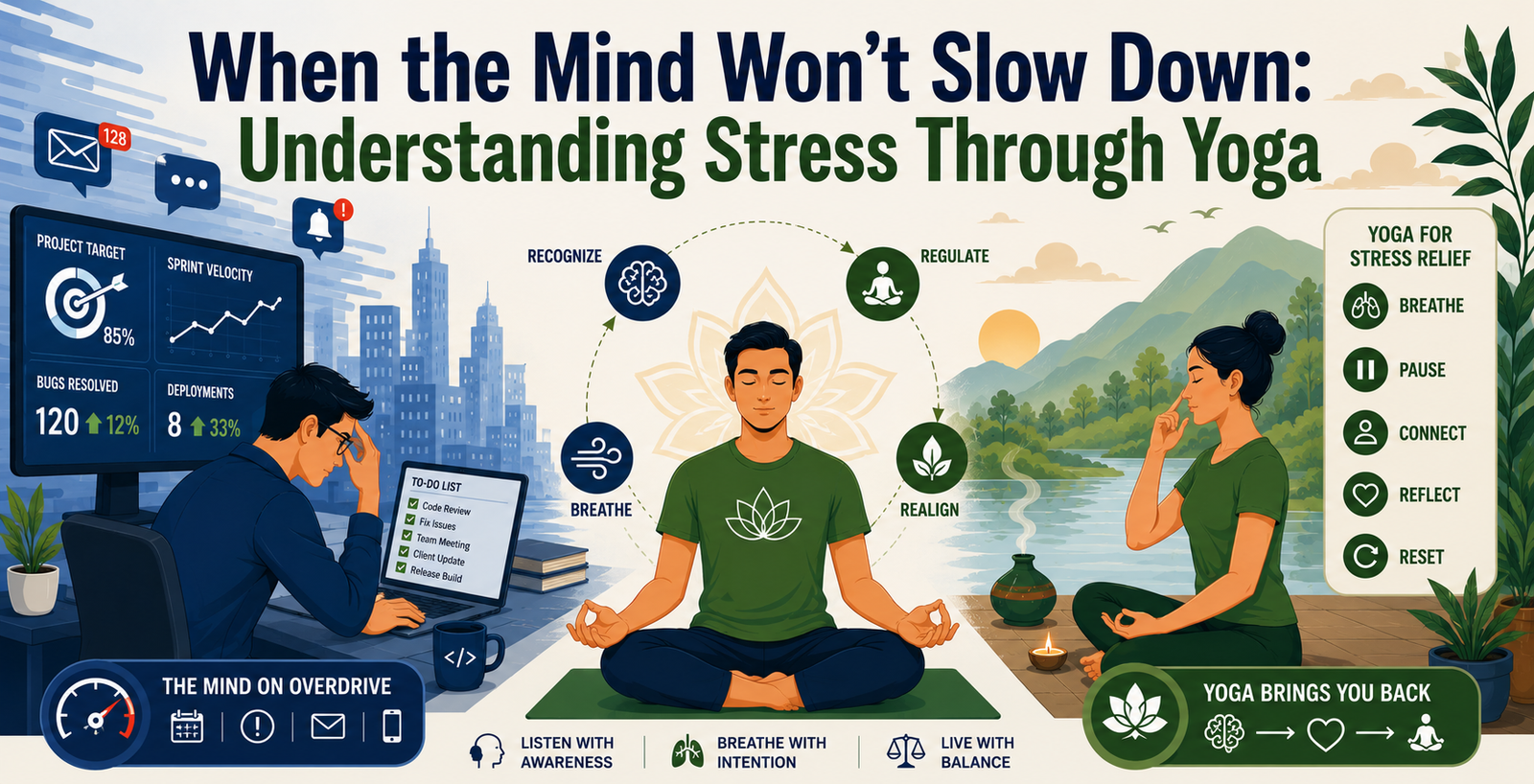
Stress Does Not Always Look Like Stress
When people hear the word stress, they often imagine someone who is visibly anxious, overloaded or emotionally disturbed.
But stress can also become so familiar that we stop recognising it.
Long working hours become normal.
Poor sleep becomes normal.
Constant digital stimulation becomes normal.
Eating while scrolling becomes normal.
Suppressing emotions becomes normal.
Saying “yes” when we want to say “no” becomes normal.
Being permanently available becomes normal.
Living this way for months or years can make a person believe:
“This is simply how life is.”
The problem is that the nervous system may be carrying a burden even when the conscious mind has learnt to call that burden normal.
This is particularly relevant in fast-moving corporate, banking and IT environments, where performance, deadlines, communication and social expectations can constantly pull a person in different directions.
How We Try to Fill the Inner Void
When people experience an uncomfortable inner emptiness, the natural reaction is often to fill it.
The difficulty is that we may try to fill an emotional or psychological void with external stimulation.
For one person, it may be excessive work.
For another, constant social media.
Someone may overeat whenever they feel emotionally uncomfortable.
Others may turn towards smoking, alcohol or other substances.
Some repeatedly seek relationships, entertainment, shopping or validation.
Even continuous productivity can become an escape.
The activity itself is not always the central problem. The important question is:
“What am I trying not to feel when I keep myself constantly occupied?”
Without awareness, many coping behaviours become automatic stress responses.
Yoga asks us to do something different.
Instead of immediately filling the space, it teaches us first to observe it.
The Gap Between Kāyika, Vācika and Mānasika Karma
During deeper conversations with people experiencing this inner conflict, I often find one theme worth exploring: the growing distance between three dimensions of our everyday behaviour.
Kāyika Karma- Physical Action
What am I actually doing?
Vācika Karma- Speech
What am I saying to others?
Mānasika Karma- Mental Activity
What am I genuinely thinking, feeling and intending?
In simple language:
What I do.
What I say.
What I think.
Ideally, these three do not need to be identical every moment, but there should be reasonable harmony between them.
Consider a simple example.
A person is exhausted and does not want to take another responsibility.
His mind says:
“I really need some rest.”
But his speech says:
“No problem. I’ll do it.”
His body then spends several additional hours completing the task.
One such incident may be harmless.
But imagine repeating this pattern hundreds of times.
Gradually, a person may become disconnected from his own needs, boundaries and values.
When Outer Behaviour and Inner Reality Keep Separating
This lack of congruence can appear in many forms:
– constantly pleasing others while carrying resentment inside,
– saying things we do not genuinely mean,
– hiding discomfort instead of communicating respectfully,
– presenting an image of success while privately feeling disconnected,
– repeatedly acting against our own values,
– becoming manipulative to maintain an image or relationship,
– denying an uncomfortable reality,
– or repeating a negative behavioural pattern while telling ourselves that nothing is wrong.
Over time, we may stop asking an important question:
“Am I living in a way that feels truthful to me?”
From a yogic perspective, inner balance involves reducing unnecessary conflict between thought, speech and action.
This idea also resonates with the Bhagavad Gita’s discussion of discipline at the levels of the body, speech and mind.
Yoga, therefore, is not merely about making the body flexible.
It is also about making life more integrated.
Why Harmony Matters
When thought, speech and action repeatedly oppose one another, a significant amount of mental energy is spent maintaining the contradiction.
You think one thing.
You communicate another.
You do something else.
Then you have to justify your action internally.
This can create restlessness, guilt, dissatisfaction, resentment or confusion.
Harmony does not mean saying everything that enters the mind or acting impulsively.
It means developing enough awareness that our actions and communication increasingly reflect clarity, responsibility and our deeper values.
That is where yoga becomes highly practical.
Three Yogic Practices to Harmonise Body, Speech and Mind
If the objective is to work with Kāyika, Vācika and Mānasika Karma together, I prefer practices in which the body, speech and mind participate in one coordinated activity.
1. Mantra Japa with Stable Posture and Awareness
Sit comfortably in a steady posture.
Allow the breath to become natural.
Begin repeating a chosen mantra gently, either aloud or softly.
Do not make the practice purely mechanical. Keep awareness connected to the sound, rhythm and meaning of the mantra.
In this practice:
Kāyika: The body maintains a stable and relaxed posture.
Vācika: Speech participates through mantra repetition.
Mānasika: The mind remains connected with the mantra and its meaning.
When all three participate in one direction, scattered attention gradually begins to collect itself.
Ten mindful minutes can be more valuable than mechanically completing a large number of repetitions.
2. Sūrya Namaskāra with Mantra, Breath and Awareness
Sūrya Namaskāra can become much more than physical exercise.
Perform the movements slowly.
Coordinate every movement with the appropriate inhalation or exhalation.
Where suitable to your tradition and practice, include the Surya mantras.
Most importantly, maintain awareness.
Observe the movement.
Observe the breathing.
Observe your mental state.
Cultivate gratitude rather than competition.
Here again:
Kāyika: The body moves through the sequence.
Vācika: Mantra gives direction to speech.
Mānasika: Awareness, concentration and gratitude involve the mind.
The purpose is not simply to complete more rounds.
The purpose is integration.
3. Mindful Seva and Karma Yoga
Perhaps the most important practice happens after we leave the yoga mat.
Choose one ordinary action each day.
It may be serving food, teaching, helping someone, cleaning your room, caring for your parents or completing a professional responsibility.
Perform that action carefully.
Let the body participate fully.
Use respectful and measured speech.
At the mental level, cultivate a simple intention:
“I will perform this action sincerely, without unnecessary irritation, ego or expectation.”
This is where yoga enters daily life.
The kitchen becomes a practice space.
The office becomes a practice space.
Communication becomes a practice.
Relationships become a practice.
A Simple Daily Three-Karma Check
At the end of the day, spend three minutes asking yourself:
What did I do today?
Was my physical action appropriate and responsible?
What did I say today?
Was my communication truthful, necessary and respectful?
What was happening in my mind?
Were my intentions and thoughts reasonably aligned with my behaviour?
Do not turn this reflection into self-criticism.
The purpose is awareness.
Once a contradiction becomes visible, it becomes possible to work with it.
Common Mistakes to Avoid
Trying to create harmony does not mean forcing yourself to think positively all the time.
It does not mean suppressing anger.
It does not mean smiling when you are hurt.
And it certainly does not mean ignoring genuine psychological distress.
Another mistake is using spirituality to escape difficult realities.
Mantra, meditation or pranayama should help us become more capable of seeing reality clearly—not become methods of avoiding necessary conversations, decisions or professional help.
If feelings of emptiness are persistent, intense, associated with hopelessness, major sleep or appetite changes, loss of interest, self-harm thoughts or significant difficulty functioning, consultation with a qualified mental-health professional is important.
Yoga can be deeply supportive, but it should not be used to dismiss symptoms that require clinical attention.
A Quick Checklist for Inner Harmony
Before sleeping tonight, ask:
– Did my actions reflect my real priorities?
– Did I say something today merely to please someone?
– Did I avoid communicating something important?
– Did I behave against my own values?
– Did I use food, work, screens or another habit mainly to avoid uncomfortable emotions?
– Did I give myself even ten quiet minutes?
– Were my body, speech and mind working together during at least one activity today?
You do not need seven perfect answers.
You only need honest ones.
Awareness is where change begins.
My Experience as a Yoga Therapist
In my work, I increasingly find that people do not always need another activity added to an already crowded schedule.
Sometimes they need an opportunity to observe how they are living.
Yoga provides that opportunity.
Āsana helps us observe the body.
Prāṇāyāma brings awareness to breathing and internal regulation.
Meditation exposes the movement of the mind.
Mantra gives the mind and speech a shared focus.
Karma Yoga takes awareness into everyday action.
Together, these practices help yoga move from being a one-hour activity to becoming a way of organising life.
Frequently Asked Questions
1. Is feeling empty always a sign of depression?
No. Temporary emptiness can occur for different emotional, social or situational reasons. However, persistent or severe symptoms should be discussed with a qualified mental-health professional.
2. Can stress exist even when I do not feel stressed?
Yes. People can become accustomed to demanding routines and may no longer consciously label them as stressful.
3. What is Kāyika Karma?
Kāyika Karma refers to actions performed through the body.
4. What is Vācika Karma?
Vācika Karma refers to actions expressed through speech and communication.
5. What is Mānasika Karma?
Mānasika Karma refers to the mental dimension-thoughts, intentions and internal attitudes.
6. Why should these three be harmonious?
Greater congruence between thought, speech and action can reduce unnecessary inner conflict and support clarity and authenticity.
7. Which yoga practice works on all three simultaneously?
Mantra Japa performed with stable posture, conscious breathing and attention to meaning is an excellent integrated practice.
8. Can Sūrya Namaskāra become a meditative practice?
Yes. When movement, breathing, mantra and awareness are coordinated, Sūrya Namaskāra becomes much more than physical exercise.
9. How does Karma Yoga help?
It trains us to bring awareness, responsibility and a healthier mental attitude into ordinary actions.
10. How long should I practise every day?
Begin with 10–20 minutes of sincere, attentive practice rather than focusing primarily on duration.
11. Can yoga replace psychological counselling?
No. Yoga can complement emotional and psychological care, but significant or persistent mental-health symptoms may require professional evaluation.
12. What is the simplest practice to begin today?
Before sleeping, reflect for three minutes on what you did, said and thought during the day. Notice where harmony existed and where unnecessary contradictions appeared.
From Emptiness to Awareness
We often hear the old expression, “An empty mind is the devil’s workshop.”
But perhaps the problem is not simply that the mind is empty.
Sometimes the deeper problem is that our actions are moving in one direction, our words in another and our mind somewhere else entirely.
Yoga invites us to bring them home.
Kāya — body.
Vāk — speech.
Manas — mind.
When these begin to cooperate rather than constantly contradict one another, life can become clearer, more grounded and more purposeful.
The goal is not perfection.
The goal is increasing harmony.
And sometimes, what appears to be a void asking to be filled may actually be an invitation asking us to listen.