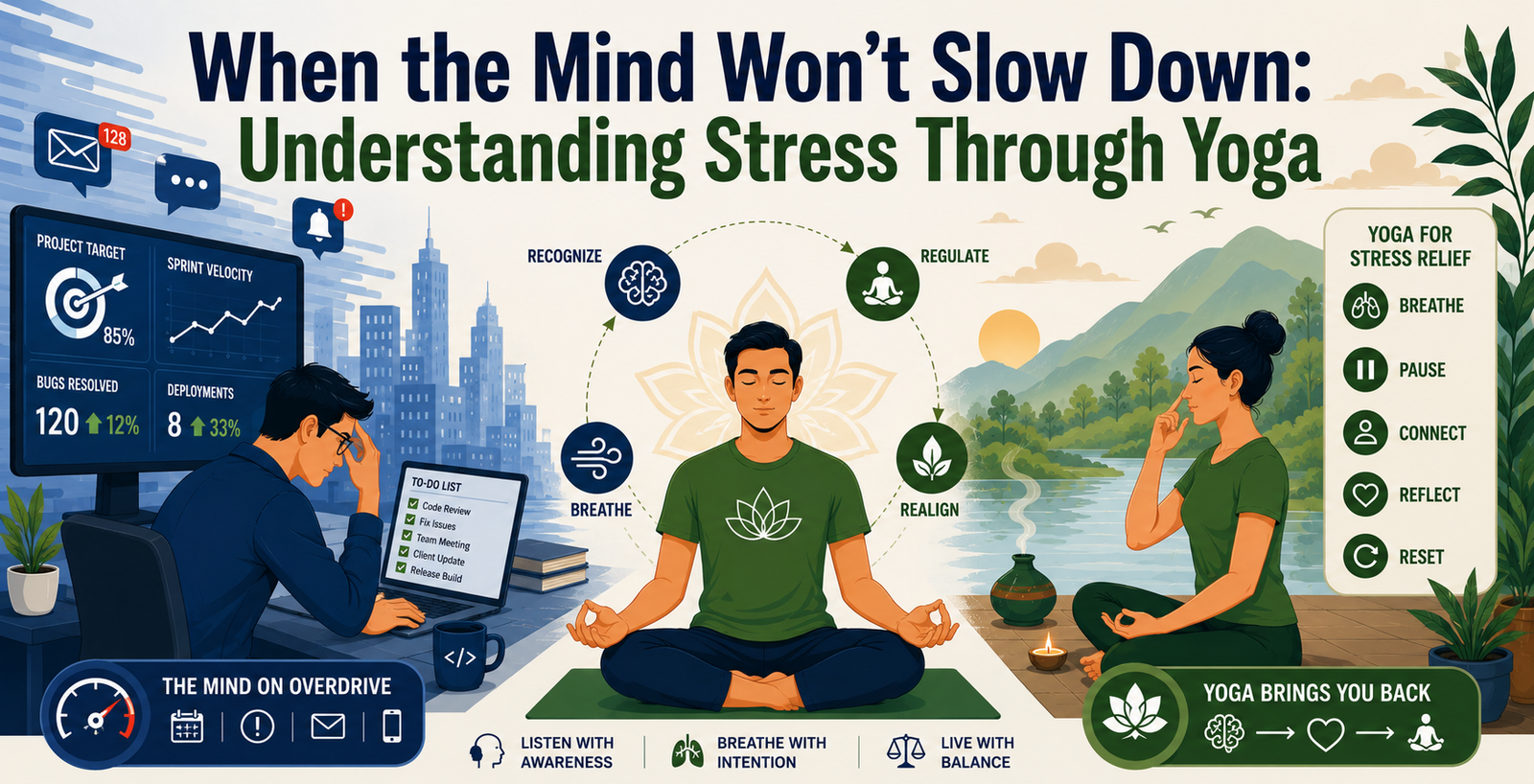
When the Mind Won’t Slow Down: Understanding Stress Through Yoga
When the Mind Never Really Stops
As a stress management consultant working with professionals in the IT sector, I regularly interact with a highly energetic, intelligent, and target-oriented population.
Their energy itself is not the problem.
The challenge begins when that energy becomes almost entirely future-oriented.
What is the next target?
What is the next deadline?
What happens after this project?
What is my next appraisal?
What should I achieve next?
Gradually, planning stops being an occasional activity and becomes the default state of the mind.
A person may be physically sitting in the present moment while mentally living several hours, days, or even years ahead.
This creates an interesting contradiction: people may become highly efficient at managing projects, deadlines, and technology, yet increasingly struggle to manage the speed of their own minds.
What Is Stress From a Yogic Perspective?
Stress can be understood as an uncontrolled speed of the mind. When thoughts continuously multiply without sufficient awareness, pause, or regulation, mental activity can develop into restlessness, emotional reactivity, and physical tension. Yoga attempts to restore balance by cultivating awareness and gradually reducing unnecessary mental and sensory stimulation.
Think of what happens with a single thought.
A thought enters the mind.
Another thought becomes associated with it.
That creates an emotion.
The emotion generates another chain of thoughts.
Soon, what began as one small concern can develop into an entire whirlpool of imagination, fear, anticipation, memory, and emotional reaction.
The mind, which is already a complex field of thoughts, impressions, memories, and sensory experiences, becomes increasingly restless.
This is why stress is not always about how many problems we have.
Sometimes it is about how rapidly the mind is processing them.
Why Mental Speed Matters
Speed is useful when it is under our control.
A fast mind can analyse, calculate, innovate, and solve problems efficiently. This is particularly valuable in industries such as information technology.
But speed without regulation is different.
Imagine driving a powerful car. Its ability to move quickly is an advantage only when the driver can accelerate, slow down, and stop when necessary.
The same principle applies to the mind.
The real problem is not:
“Can my mind think fast?”
The more important question is:
“Can my mind slow down when speed is no longer required?”
This is where many people struggle.
Constant notifications, screens, meetings, deadlines, social media, entertainment, and information consumption ensure that sensory input rarely stops.
With continuous sensory input, continuous stimulation can gradually begin to feel normal.
Silence then feels uncomfortable.
Waiting feels irritating.
Doing nothing feels unproductive.
And relaxation itself can become difficult.
When Comfort Does Not Create Relaxation
One of the clearest signs of this imbalance is the inability to experience comfort even when comfortable conditions are available.
A person may have the most luxurious bed and still spend the night unable to sleep.
Another person may have delicious food on the plate but eat while scrolling through a phone, thinking about work, or worrying about tomorrow-barely experiencing the taste of the meal.
The external environment may provide comfort.
The mind may still refuse to participate in it.
This distinction is important.
Comfort is something the environment can provide. Relaxation is something the nervous system and mind must be capable of experiencing.
When internal speed remains high, external luxury alone cannot guarantee rest.
5 Early Signs That Mental Stress Is Entering the Body
Mental stress does not necessarily remain confined to our thoughts. Over time, psychological strain can be accompanied by changes in sleep, muscular tension, digestion, concentration, and behaviour.
Here are five signs worth noticing.
1. Constant Restlessness and the Inability to Relax
A person may constantly feel “on edge,” even when nothing particularly stressful is happening at that moment.
Externally, this may sometimes appear as:
– repeatedly shaking or bouncing the legs
– fidgeting with the hands
– constantly checking the phone
– difficulty sitting quietly
– rapid or excessive talking
– repeatedly shifting attention
– feeling compelled to remain occupied
Not every restless movement indicates stress. However, when persistent restlessness occurs together with mental tension and difficulty relaxing, it deserves attention.
The person may say:
“Nothing is wrong, but I simply cannot switch off.”
That sentence itself tells us something important.
The external trigger may have disappeared, but its internal momentum continues.
2. Disturbed Sleep and Irregular Sleep Patterns
Sleep is often one of the first areas where excessive mental activity becomes noticeable.
Common experiences include:
– difficulty falling asleep
– waking repeatedly during the night
– waking earlier than intended
– sleeping for several hours but feeling unrefreshed
– using phones or entertainment late into the night
– having racing thoughts immediately after lying down
This deserves particular attention among younger professionals whose work, entertainment, and social lives may all happen through the same digital devices.
Sleep is not simply “doing nothing.”
It is an essential biological recovery process.
When irregular schedules, late-night stimulation, and mental overactivity repeatedly interfere with sleep, daytime energy, mood, attention, and productivity can also suffer.
3. Tension in the Neck, Shoulders, and Jaw
The body often reveals what the mind is carrying.
Under prolonged psychological pressure, some people unconsciously maintain muscular tension.
The shoulders remain elevated.
The jaw stays clenched.
The forehead remains tight.
The neck becomes stiff.
Some people may also experience tension-type headaches or aggravation of headache patterns.
Even posture can begin to reflect the internal state. Long hours at computers combined with stress-related muscular tension can contribute to a visibly stiff or rounded posture.
This is why stress management should not focus only on thoughts.
The body must also be taught how to release unnecessary effort.
4. Digestive Changes
The digestive system and the brain communicate extensively through what is commonly described as the gut-brain axis.
Many people notice that their digestive system responds during periods of psychological pressure.
They may experience:
– acidity or heartburn
– bloating
– indigestion
– changes in appetite
– altered bowel habits
– abdominal discomfort
This does not mean every digestive problem is caused by stress. Persistent or significant digestive symptoms require appropriate medical evaluation.
However, ignoring the role of stress can also leave an important part of the picture unexplored.
Eating itself provides a useful example.
If we eat while answering messages, watching videos, rushing to meetings, or mentally rehearsing tomorrow’s problems, the body is receiving food while the mind remains somewhere else.
A simple meal can therefore become another task rather than an experience of nourishment.
5. Difficulty Focusing and Making Simple Decisions
A fast mind is not necessarily a focused mind.
When multiple uncontrolled thoughts compete simultaneously for attention, concentration can become difficult.
A person may experience:
– racing thoughts
– forgetfulness
– difficulty completing one task
– repeatedly moving between applications or activities
– indecisiveness
– reduced attention span
– difficulty being fully present in conversations
There is also a temporal dimension to this.
The mind frequently oscillates between two places:
the remembered past and the imagined future.
We replay something that has already happened or anticipate something that has not happened yet.
Both activities have their place.
Memory helps us learn.
Planning helps us prepare.
But when either becomes compulsive, the present moment receives very little attention.
A Practical Example From Modern Work Life
Consider a professional who finishes work at 7:00 PM.
The laptop closes, but mentally the workday continues.
During dinner, tomorrow’s presentation is being rehearsed internally.
During family time, notifications are being checked.
While lying in bed, the mind reviews unfinished tasks.
The body has technically left the workplace.
The mind has not.
This is an important distinction in stress management.
Recovery does not begin merely because working hours have ended.
Recovery begins when the internal system receives permission to disengage.
How Yoga Approaches This Mental Speed
Yoga does not necessarily ask us to become slow, passive, or unambitious.
Instead, it develops the capacity to regulate ourselves.
We should be able to act intensely when action is required and withdraw from that intensity when it is no longer necessary.
Several yogic practices can support this transition.
Asana
Mindful movement redirects attention from abstract thinking towards bodily awareness.
Pranayama
Conscious regulation of breathing gives us an opportunity to observe and influence our internal rhythm.
Pratyahara
Reducing unnecessary sensory engagement can create space between ourselves and constant external stimulation.
Dharana
Training attention on one chosen object develops the ability to remain with one experience rather than continuously jumping between stimuli.
Dhyana
Meditative practices gradually cultivate sustained awareness and a different relationship with mental activity.
The objective is not to forcibly eliminate every thought.
It is to develop enough awareness that every thought does not automatically carry us away.
A Simple Daily Framework for Slowing Mental Speed
Try introducing three small pauses into your day.
Morning: Spend a few minutes observing your natural breathing before checking your phone.
Between work periods: Step away from the screen, relax your jaw and shoulders, and take a few slow, comfortable breaths.
Before sleep: Create a short period without work-related or stimulating digital input and allow the mind to transition towards rest.
The practice sounds simple.
Its difficulty reveals how deeply constant stimulation has become part of modern conditioning.
Common Mistakes in Managing Stress
One mistake is waiting until stress becomes overwhelming before doing anything about it.
Another is assuming that entertainment automatically equals relaxation. Watching videos or scrolling endlessly may distract the mind without necessarily allowing it to settle.
A third mistake is treating every physical symptom as “just stress.”
Yoga and stress-management practices can be supportive, but persistent pain, severe headaches, significant digestive problems, prolonged insomnia, or substantial psychological distress deserve appropriate professional evaluation.
Self-awareness and appropriate healthcare should complement each other.
Quick Stress Awareness Checklist
Ask yourself:
– Can I sit quietly for five minutes without reaching for my phone?
– Can I eat one meal without digital stimulation?
– Can I stop thinking about work after working hours?
– Do I wake feeling reasonably refreshed?
– Are my jaw and shoulders frequently tense?
– Do I constantly feel that I should be doing something?
– Can I focus on one activity without repeatedly switching?
– When nothing is happening, do I experience peace-or discomfort?
These questions are not diagnostic tools.
They are invitations to observe your own internal speed.
Frequently Asked Questions
1.What is stress according to Yoga?
From a practical yogic perspective, stress can be understood as a state in which mental activity, sensory stimulation, and emotional reactions become difficult to regulate.
2. Is thinking fast always a sign of stress?
No. Fast thinking can be useful and productive. The problem arises when the mind cannot slow down when rest or focused attention is required.
3. Can stress affect sleep?
Yes. Mental and physiological arousal can make falling asleep, staying asleep, or feeling refreshed after sleep more difficult.
4. Why does stress create muscle tension?
Psychological pressure can be accompanied by increased muscular activation, particularly around areas such as the neck, shoulders, face, and jaw.
5. Can stress affect digestion?
Stress can influence digestive functioning through complex communication between the brain, nervous system, and gastrointestinal system.
6. Can Yoga help with stress management?
Yoga practices may support stress management by combining movement, breathing, attention regulation, relaxation, and meditation.
7. Which Yoga practice is best for stress?
There is no single practice suitable for everyone. Gentle asana, comfortable breathing practices, relaxation, and meditation can be useful depending on the individual.
8. Is restlessness an early sign of stress?
Persistent restlessness can accompany stress, particularly when it occurs with racing thoughts, muscular tension, sleep disturbance, or difficulty relaxing.
9. Why do I feel tired even after sleeping?
Poor sleep quality, irregular sleep timing, stress, and many medical or lifestyle factors can contribute. Persistent fatigue should be appropriately evaluated.
10. Does scrolling on the phone help us relax?
It may provide distraction or entertainment, but continuous digital stimulation is not necessarily the same as physiological or mental relaxation.
11. What is the difference between comfort and relaxation?
Comfort describes favourable external conditions. Relaxation describes an internal state in which unnecessary physical and mental tension reduces.
12. How can IT professionals manage everyday stress?
Creating boundaries around work, taking regular movement and breathing breaks, protecting sleep, reducing unnecessary digital stimulation, and maintaining a regular Yoga or relaxation practice can help.
The Real Skill Is Knowing How to Slow Down
Stress is not always loud.
It does not always arrive as a breakdown, panic, or obvious emotional disturbance.
Sometimes it begins quietly-as an almost invisible increase in the speed of the mind.
One thought becomes ten. One worry becomes an entire imagined future. The body gradually follows: the shoulders tighten, sleep becomes lighter, digestion changes, and concentration becomes fragmented.
The answer is not necessarily to abandon ambition or become less energetic.
The deeper skill is regulation.
There should be a time to think rapidly and a time to become quiet.
A time to achieve and a time to recover.
A time to engage with the world and a time to withdraw from its endless stimulation.
Perhaps one of the most practical purposes of Yoga in modern life is precisely this:
to teach us how to slow the inner speed without losing our outer effectiveness.
If your mind continues working even after your workday has ended, stress management may need to begin not with doing more, but with learning how to consciously slow down.
Explore practical Yoga, pranayama, relaxation, and stress-management resources at Athatoyoga and begin developing the ability to move efficiently when action is required-and become still when it is not.