The Devi Within: Nine Spiritual Qualities for Everyday Living
Exploring Navaratri, the nine forms of Maa Durga, and their relevance to Yoga and everyday life.
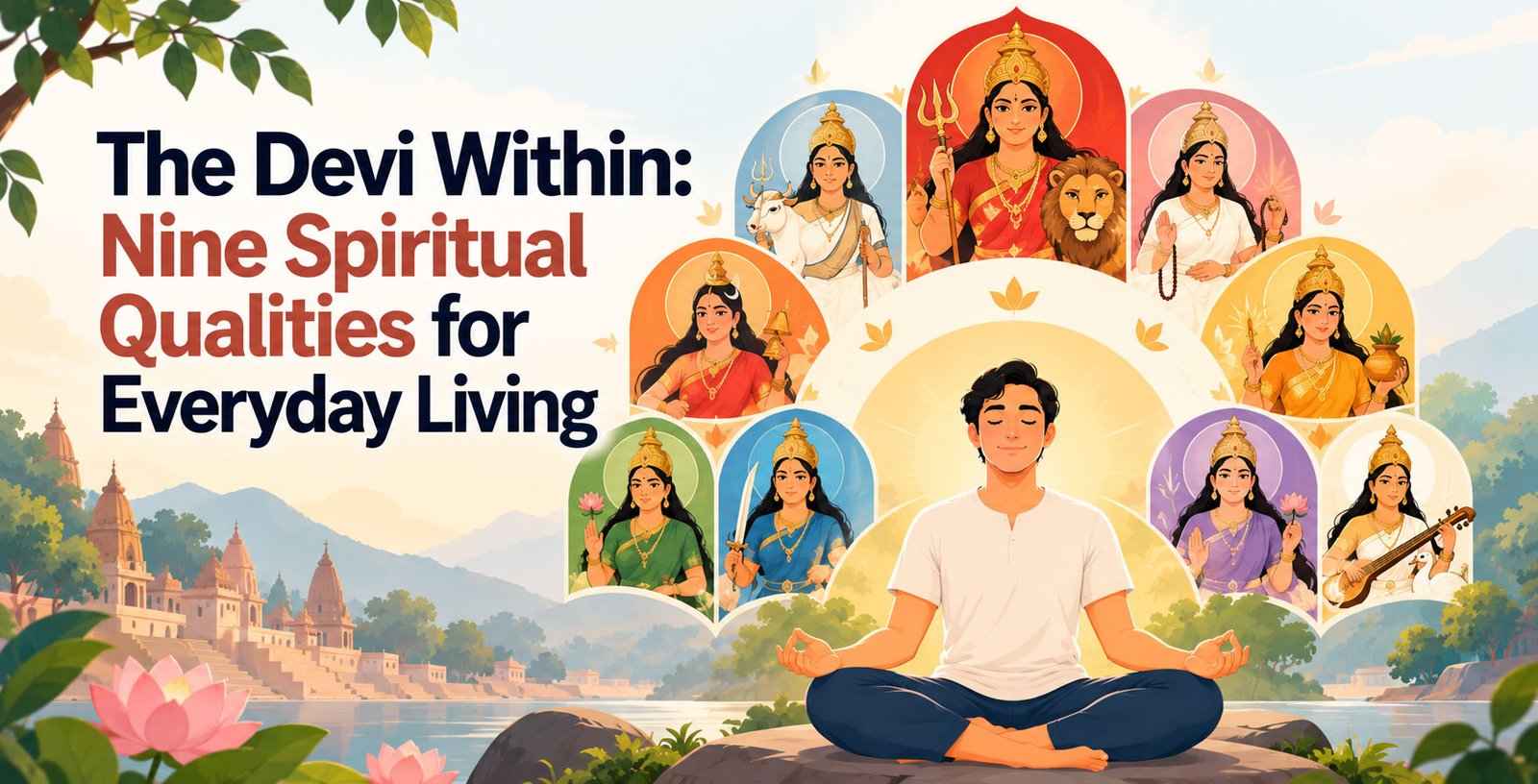
Navaratri is traditionally a time of devotion, worship, fasting, and spiritual reflection. For nine nights, devotees worship the Divine Mother in her nine forms, collectively known as Navadurga.
But beyond the rituals and celebrations, Navaratri offers us an opportunity to reflect on something deeply personal: How can the qualities represented by the Divine Mother become part of our everyday lives?
The nine forms of Maa Durga can inspire nine spiritual qualities: stability, discipline, courage, gratitude, compassion, determination, non-attachment, purity, and wisdom. Through Yoga, self-observation, and conscious living, these qualities can gradually become part of how we think, speak, act, and respond to life’s challenges.
The Divine Mother: Beyond the Victory Over Mahishasura
The Devī Māhātmya, traditionally attributed to Sage Markandeya and preserved within the Mārkaṇḍeya Purāṇa, describes the glory and divine manifestations of the Goddess.
One of its most celebrated episodes narrates the victory of Maa Durga over Mahishasura, the powerful Asura who had defeated the Devas.
Following his defeat, the Devas glorify the Goddess, recognising her divine power and her role in sustaining and protecting the universe.
Elsewhere in the Devī Māhātmya, particularly in the fifth chapter, the Devas offer another beautiful hymn recognising the Goddess as the divine presence manifesting through consciousness, intelligence, compassion, peace, and other aspects of existence.
One verse is especially meaningful when viewed through the lens of Yoga:
या देवी सर्वभूतेषु चेतनेत्यभिधीयते।
नमस्तस्यै नमस्तस्यै नमस्तस्यै नमो नमः॥
Yā devī sarvabhūteṣu cetanetyabhidhīyate,
Namastasyai namastasyai namastasyai namo namaḥ.
Meaning: Salutations again and again to the Divine Mother, who is present in all beings in the form of consciousness.
In the tradition of Yoga, awareness plays a fundamental role in self-observation and inner transformation.
This verse invites us to contemplate the Divine Mother’s presence not merely as an external divinity, but also as the consciousness through which we experience and understand life.
With this understanding, let us explore the nine forms of Maa Durga as inspirations for cultivating nine spiritual qualities in everyday living.
Nine Forms of Maa Durga and Their Spiritual Significance
1. स्थैर्य (Sthairya) – Stability
Maa Shailaputri | The Strength to Remain Grounded
Maa Shailaputri, the daughter of the mountain, symbolises strength and steadfastness.
Life is constantly changing. Relationships, responsibilities, health, and circumstances may not always unfold according to our expectations.
Inner stability does not mean that we stop experiencing emotions. Rather, it is the ability to remain aware and balanced even when circumstances become difficult.
Yoga encourages steadiness of body, breath, and mind. This steadiness gradually supports our ability to face uncertainty without being overwhelmed by it.
Daily practice: When faced with a stressful situation, pause for a few moments. Observe your breathing, acknowledge your emotions, and choose a conscious response instead of reacting impulsively.
Reflection: Am I allowing external circumstances to determine my inner peace?
2. अनुशासन (Anuśāsana) – Discipline
Maa Brahmacharini | The Power of Consistency
Maa Brahmacharini represents tapas, dedication, and perseverance in spiritual practice.
We often begin something with great enthusiasm, only to lose interest when results are not immediately visible.
However, meaningful transformation requires sustained effort.
Patanjali explains the importance of Abhyāsa (consistent practice) in Yoga Sutras 1.13–1.14. Practice becomes firmly established when cultivated over a long period, without interruption, and with sincere dedication.
Discipline should not become punishment or rigid self-control. It is a conscious commitment to what truly matters.
Daily practice: Dedicate ten minutes every day to meditation, mindful breathing, or self-reflection. Give importance to consistency rather than duration.
Reflection: Are my everyday habits supporting the person I wish to become?
3. धैर्य (Dhairya) – Courage and Fortitude
Maa Chandraghanta | Strength Guided by Wisdom
Maa Chandraghanta represents courage, protection, and the strength to face adversity.
Courage is often misunderstood as fearlessness. In reality, courage is the willingness to act wisely even when fear is present.
Sometimes courage means speaking the truth. At other times, it means accepting a difficult reality, asking for help, or walking away from an unhealthy situation.
Yogic awareness encourages us to recognise fear without allowing it to dictate every decision.
Courage guided by wisdom is more valuable than aggression driven by emotion.
Daily practice: Identify one situation you have been avoiding. Approach it calmly, with clarity and without unnecessary confrontation.
Reflection: Where in my life do I need to act with greater courage?
4. कृतज्ञता (Kṛtajñatā) – Gratitude
Maa Kushmanda | Recognising Life’s Abundance
Maa Kushmanda is traditionally associated with cosmic creation and the life-giving energy of the universe.
Her symbolism can inspire us to recognise the value of life and the abundance that often goes unnoticed.
Our minds are frequently occupied with what we lack: greater success, better opportunities, more possessions, or recognition.
In this constant pursuit, we may overlook the simple blessings already present.
The Yogic principle of Santoṣa (contentment), one of the Niyamas described by Patanjali, reminds us that fulfilment need not depend entirely on external achievements.
Gratitude does not mean abandoning ambition. It means learning to appreciate the present while continuing to grow.
Daily practice: Before sleeping, acknowledge three things you are grateful for, however ordinary they may seem.
Reflection: Am I overlooking the blessings already present in my life?
5. करुणा (Karuṇā) – Compassion
Maa Skandamata | Strength Through Kindness
Maa Skandamata, the nurturing mother of Skanda, represents maternal love, protection, and compassion.
Compassion is not merely feeling sympathy for another person. It involves recognising their difficulties and responding with understanding.
In Yoga Sutra 1.33, Patanjali identifies Maitrī (friendliness) and Karuṇā (compassion) among the attitudes that help cultivate clarity and tranquillity of mind.
In everyday life, we often judge people based on their behaviour without knowing the struggles they may be experiencing.
Compassion encourages us to look beyond immediate reactions.
It also reminds us to extend kindness towards ourselves, especially when we make mistakes or fall short of expectations.
Daily practice: Listen to someone patiently without interrupting, judging, or immediately offering advice.
Reflection: Can I remain compassionate when others do not meet my expectations?
6. संकल्प (Saṅkalpa) – Determination
Maa Katyayani | Standing Firm in One’s Values
Maa Katyayani represents strength, determination, and the courage to confront injustice.
In everyday life, determination is not simply about achieving goals. It also involves remaining committed to our values when circumstances challenge them.
Sometimes we compromise our priorities because we fear disappointing others or seek their approval.
Yogic principles such as Tapas (disciplined effort) and Svādhyāya (self-study) encourage us to act with commitment while continually examining our intentions.
True determination requires both firmness and flexibility.
Daily practice: Set one healthy boundary. Say no to an unnecessary obligation when accepting it would compromise your well-being or important responsibilities.
Reflection: Are my decisions guided by my values or by the need for approval?
7. वैराग्य (Vairāgya) – Non-Attachment
Maa Kalaratri | Freedom from Inner Darkness
Maa Kalaratri, the fierce form of the Divine Mother, symbolises the destruction of darkness and fear.
In our inner lives, darkness may appear as resentment, insecurity, excessive attachment, or deeply rooted fears.
We sometimes continue holding on to painful experiences long after the situations themselves have passed.
Patanjali describes Vairāgya (non-attachment) as an essential aspect of Yoga, alongside Abhyāsa.
Non-attachment does not mean becoming indifferent, suppressing emotions, or withdrawing from relationships.
It means developing the freedom to experience life without being controlled by every desire, fear, or expectation.
Daily practice: Observe one recurring negative thought. Instead of resisting it or repeatedly engaging with it, acknowledge its presence and gently return your attention to the present.
Reflection: What am I holding on to that no longer supports my growth?
8. शौच (Śauca) – Inner Purity
Maa Mahagauri | Clarity in Thought, Speech, and Action
Maa Mahagauri represents purity, serenity, and spiritual refinement.
In Yoga, Śauca is one of the five Niyamas and refers to cleanliness and purity, both external and internal.
While physical cleanliness is important, inner purity invites us to examine the quality of our thoughts, intentions, speech, and actions.
It is not about becoming perfect or eliminating every negative thought.
Instead, it encourages greater honesty, clarity, and mindfulness.
The principle of Satya (truthfulness) further reminds us to cultivate harmony between what we believe, what we say, and how we behave.
Daily practice: For one day, consciously avoid unnecessary criticism, gossip, and harsh speech. Observe how this influences your state of mind and interactions.
Reflection: Are my thoughts, words, and actions moving towards greater harmony?
9. विवेक (Viveka) – Discriminative Wisdom
Maa Siddhidatri | Living with Awareness
Maa Siddhidatri is traditionally associated with spiritual accomplishments and the granting of Siddhis.
Her symbolism can also inspire us to reflect on the importance of wisdom in spiritual development.
In Yoga, Viveka refers to discriminative discernment: the ability to recognise what is essential and distinguish deeper understanding from temporary impulses.
We make countless decisions every day, often influenced by habits, emotional reactions, social expectations, or personal conditioning.
Wisdom develops when we begin to question these influences rather than automatically following them.
Patanjali gives particular importance to Vivekakhyāti, sustained discriminative insight, in Yoga Sutra 2.26.
Daily practice: Before making an important decision, pause and examine your intention. Ask whether the choice arises from clarity, fear, habit, or the desire for approval.
Reflection: Am I acting from awareness or merely repeating my conditioning?
Bringing Navaratri into Everyday Life
The significance of these nine qualities becomes clearer when we recognise that spiritual practice need not remain confined to a prayer room, meditation cushion, or Yoga mat.
Consider an ordinary day.
A disagreement at home gives us an opportunity to practise stability. Maintaining a daily routine strengthens discipline. Facing a difficult conversation requires courage. Appreciating a simple meal cultivates gratitude.
Listening patiently develops compassion. Respecting personal boundaries strengthens determination. Releasing resentment encourages non-attachment. Speaking truthfully supports inner purity, while making thoughtful decisions develops wisdom.
In this way, everyday experiences become opportunities for spiritual practice.
We can consciously bring these qualities into three dimensions of life:
– Kāya (काय) – Body: Through mindful actions, healthy routines, and responsible conduct.
– Vāc (वाच्) – Speech: Through truthful, compassionate, and thoughtful communication.
– Manas (मनस्) – Mind: Through awareness, self-observation, and emotional balance.
When our body, speech, and mind gradually move towards harmony, spiritual understanding begins to influence our actual behaviour.
A Simple Nine-Day Navaratri Practice
Each day of Navaratri can become an opportunity to cultivate one spiritual quality.
Day| Quality| Simple Practice
1| Stability| Pause before reacting
2| Discipline| Practise meditation for ten minutes
3| Courage| Face one difficult situation calmly
4| Gratitude| Acknowledge three blessings
5| Compassion| Listen without judgment
6| Determination| Establish one healthy boundary
7| Non-Attachment| Observe and release identification with a recurring thought
8| Inner Purity| Practise mindful and truthful speech
9| Wisdom| Reflect before making an important decision
At the end of each day, spend a few minutes reflecting on how successfully you applied that quality.
There is no need to judge yourself harshly if you struggle. The purpose is not to achieve perfection in nine days, but to develop greater awareness of how you live.
Common Misunderstandings About Spiritual Growth
As we cultivate these qualities, a few distinctions are worth remembering.
Stability is not emotional suppression. We can experience sadness, anger, or fear while learning to respond more consciously.
Discipline is not rigidity. Consistent effort should support well-being rather than become another source of pressure.
Compassion does not require accepting harmful behaviour. Kindness and healthy boundaries can coexist.
Non-attachment is not indifference. We can love deeply, fulfil responsibilities, and pursue meaningful goals without becoming excessively dependent on outcomes.
Purity is not perfection. Spiritual growth involves recognising our limitations and making sincere efforts to improve.
These distinctions help ensure that spiritual practice remains balanced, practical, and compassionate.
Frequently Asked Questions
1. What is the spiritual significance of Navaratri?
Navaratri celebrates the Divine Mother and the victory of divine power over destructive forces. It also provides an opportunity for devotion, self-discipline, reflection, and spiritual renewal.
2. What are the nine forms of Maa Durga?
The Navadurga are Shailaputri, Brahmacharini, Chandraghanta, Kushmanda, Skandamata, Katyayani, Kalaratri, Mahagauri, and Siddhidatri.
3. How are Navaratri and Yoga connected?
Navaratri and Yoga can be connected through practices such as meditation, self-discipline, self-observation, devotion, and the cultivation of positive qualities.
4. Are the nine spiritual qualities traditional attributes of Navadurga?
The nine qualities discussed here are contemplative interpretations inspired by the symbolism of Navadurga and Yogic philosophy. They are not presented as a fixed traditional scriptural classification.
5. What does Sthairya mean in Yoga?
Sthairya means steadiness or stability. It encourages a balanced approach to physical practice and the cultivation of inner composure.
6. What is the difference between Abhyāsa and Vairāgya?
Abhyāsa refers to sustained practice, while Vairāgya refers to non-attachment. Together, they are essential principles for the regulation of mental fluctuations in Patanjali’s Yoga Sutras.
7. How can I practise compassion in daily life?
Begin by listening patiently, avoiding unnecessary judgment, recognising others’ difficulties, and responding with kindness while maintaining healthy boundaries.
8. Does non-attachment mean giving up relationships or ambitions?
No. Non-attachment involves reducing excessive dependence on outcomes, possessions, and expectations without abandoning love or responsibility.
9. What is the meaning of Śauca in Yoga?
Śauca means cleanliness or purity. As a Niyama, it encourages both physical cleanliness and inner refinement.
10. What is Viveka in Yogic philosophy?
Viveka is discriminative discernment, particularly the capacity to distinguish what is enduring from what is changing. It supports deeper self-understanding.
Awakening the Devi Within
The nine forms of Maa Durga can be contemplated not only as divine manifestations worthy of devotion, but also as inspirations for qualities we can consciously cultivate within ourselves.
Navaratri becomes even more meaningful when our Sādhanā extends beyond rituals and becomes part of everyday living.
Through the body (Kāya), speech (Vāc), and mind (Manas), we can gradually bring greater awareness into our relationships, responsibilities, decisions, and actions.
From Sthairya to Viveka, the journey through the nine nights of Navaratri can also become a Yogic journey of inner transformation.
Perhaps the deeper question of Navaratri is not only how sincerely we worship the Divine Mother, but also how consciously we allow the qualities she inspires to guide our lives.
May this Navaratri inspire us to move beyond occasional spiritual practice towards a life of greater awareness, compassion, and wisdom.
At Athatoyoga, we explore Yoga not merely as a physical discipline, but as a way of understanding ourselves and bringing awareness into everyday life.