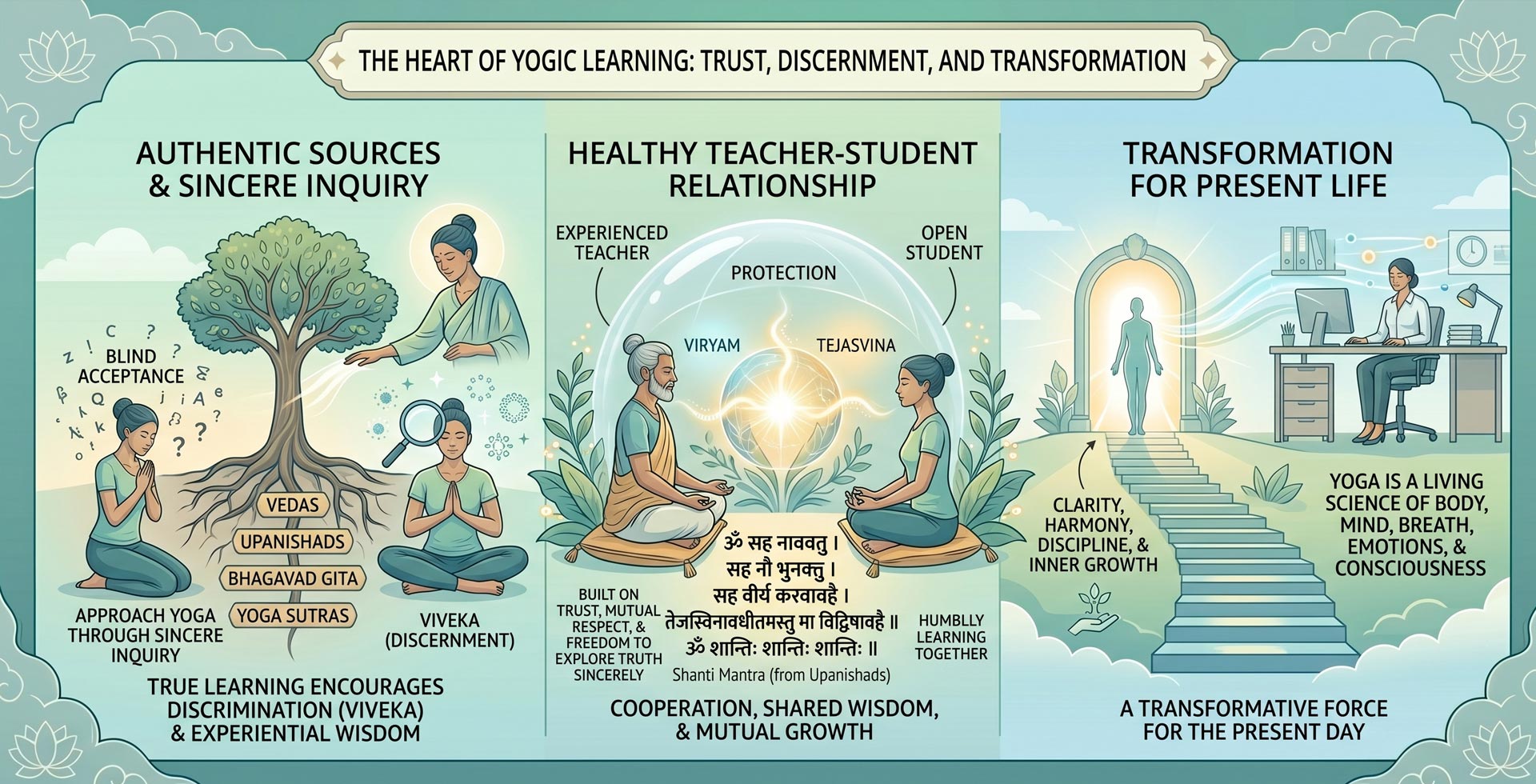
The Heart of Yogic Learning: Trust, Discernment, and Transformation
The knowledge of Yoga is ancient, profound, and timeless. Its roots extend through the wisdom of the Vedas, Upanishads, Bhagavad Gita, Yoga Sutras, and many other sacred traditions. Though these teachings emerged thousands of years ago, their relevance continues even in modern life. The human mind still struggles with stress, confusion, attachment, fear, and imbalance, and Yoga continues to offer practical tools for clarity, harmony, discipline, and inner growth. The essence of Yoga is not limited to physical postures; it is a living science of understanding the body, mind, breath, emotions, and consciousness.
Over centuries, many interpretations of yogic scriptures have emerged. Different traditions, teachers, and philosophical schools often explain the same concepts in different ways. While diversity of understanding can enrich learning, it also makes it important for a seeker to approach Yoga through authentic sources and sincere inquiry. Blind acceptance without understanding can lead to confusion or rigid belief systems. True yogic learning encourages viveka (discernment), self-observation, and experiential wisdom. A genuine teacher does not demand suppression of intelligence, but guides the student toward deeper understanding through practice, reflection, and direct experience.
In the yogic tradition, questioning has always been an essential part of learning. Many ancient scriptures themselves are written in the form of dialogues where disciples ask difficult questions and masters answer with patience and compassion. Practicality and logic are not enemies of spirituality; rather, they help ground spiritual wisdom into daily life. A healthy teacher-student relationship is built on trust, openness, mutual respect, and freedom to explore truth sincerely. When both teacher and student remain humble learners, growth happens naturally for both.
The spirit of such learning is beautifully expressed in the famous Shanti Mantra from the Upanishads:
Sanskrit Shloka:
ॐ सह नाववतु ।
सह नौ भुनक्तु ।
सह वीर्यं करवावहै ।
तेजस्विनावधीतमस्तु मा विद्विषावहै ॥
ॐ शान्तिः शान्तिः शान्तिः ॥
Transliteration:
Om Saha Nāvavatu
Saha Nau Bhunaktu
Saha Vīryam Karavāvahai
Tejasvināvadhītamastu Mā Vidviṣāvahai
Om Shāntiḥ Shāntiḥ Shāntiḥ
Meaning:
“May we both – teacher and student – be protected together.
May we both be nourished together.
May we work together with great energy and strength.
May our learning be filled with brilliance and wisdom.
May there be no hatred, conflict, or misunderstanding between us.
Om Peace, Peace, Peace.”
This mantra reflects the true foundation of yogic learning – cooperation instead of domination, wisdom instead of ego, and shared growth instead of hierarchy. Yoga flourishes where there is sincerity, inquiry, humility, and inner openness. When knowledge is approached with awareness and practiced with authenticity, Yoga becomes not merely a philosophy from the past, but a transformative force for present-day life.