Beyond the Posture: 8 Principles Every Yoga Teacher Should Encourage
Yoga is an ancient science with applications that extend far beyond physical exercise. When understood and practised with awareness, Yoga can support our physical and mental health, regulate our energy and emotions, improve the way we relate to others, and gradually deepen our understanding of ourselves.
Yet in modern Yoga classes, it is easy for the practice to become centred mainly around postures, flexibility and physical achievement.
As Yoga teachers, we have an opportunity-and a responsibility-to bring the deeper principles of Yoga into the way we teach.
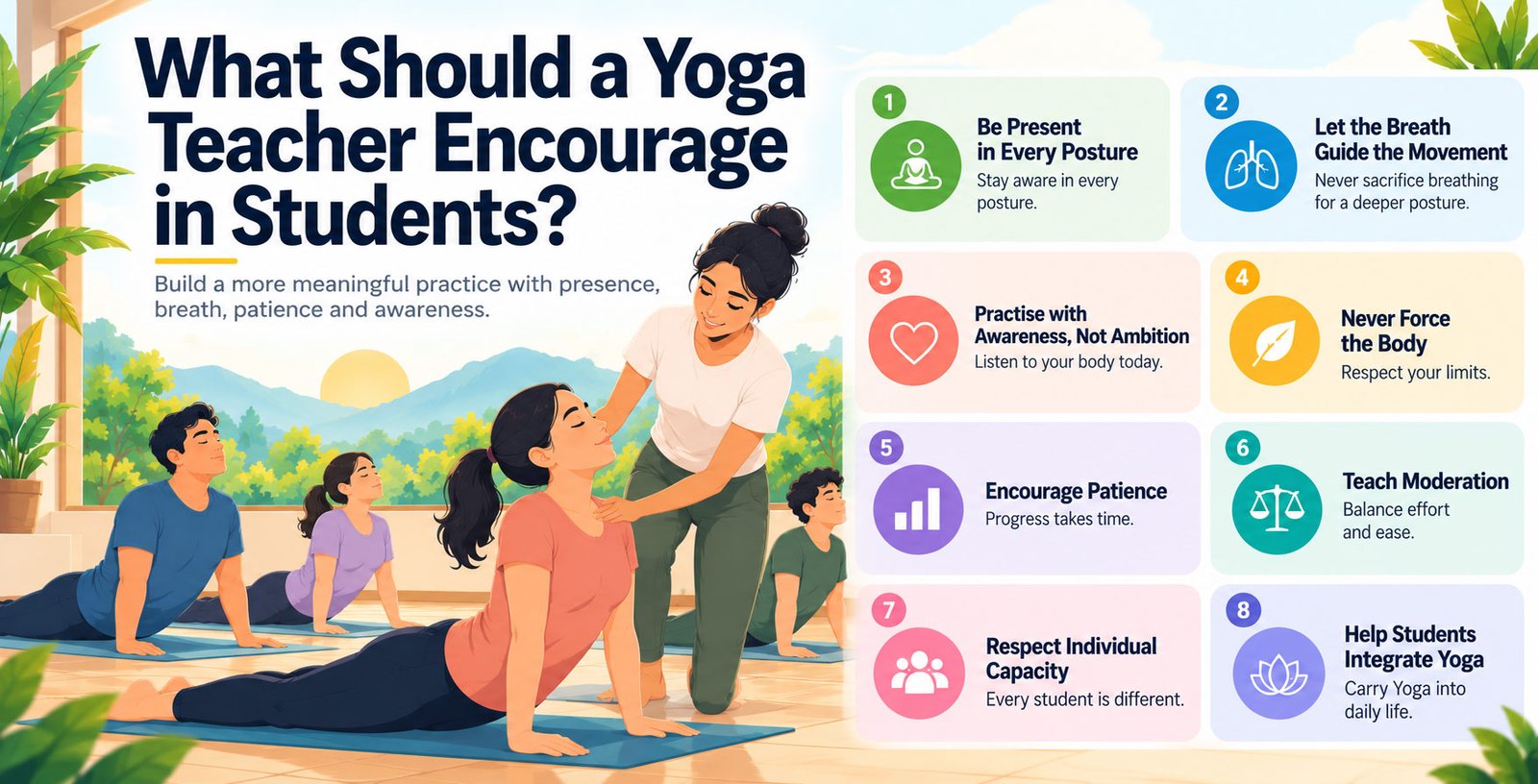
What Should a Yoga Teacher Encourage in Students?
A Yoga teacher should encourage students to practise with presence, breath awareness, patience, moderation and respect for their individual capacity. Yoga is not about achieving the deepest posture. A meaningful practice should gradually develop awareness and balance, and ideally leave the practitioner quieter and more centred than when they began.
These principles may sound simple, but when consistently included in a Yoga class, they can completely change the quality of practice.
Yoga Has Applications at Many Levels of Life
The knowledge of Yoga has been passed down through generations because its application is not limited to the physical body.
Yoga can influence us at several interconnected levels:
Physical — strength, mobility, balance and bodily awareness
Mental — concentration, clarity and steadiness of mind
Energetic — greater awareness and regulation of prāṇa through breath and practice
Emotional — developing greater awareness of our reactions and emotional patterns
Social — becoming more conscious of how we communicate and relate to others
Spiritual — encouraging self-inquiry and a deeper understanding of life and ourselves
Modern practitioners may initially come to Yoga for flexibility, back pain, stress management, fitness or relaxation. There is nothing wrong with that.
The role of the teacher is not to force philosophy upon them, but to gradually show through the practice itself that Yoga has much more to offer.
The Responsibility of a Yoga Teacher
After nearly two decades of teaching and working with Yoga, I increasingly feel that carrying this knowledge forward is a responsibility.
A teacher is not merely demonstrating techniques.
We are passing on a tradition.
Different traditional and modern schools may present Yoga philosophy in different ways. Students also come from different backgrounds, beliefs and expectations. Therefore, I believe Yoga should be taught without unnecessary bias or imposition.
Our responsibility is to make the principles accessible while respecting the student.
Many practitioners today naturally remain more oriented towards the physical and mental aspects of Yoga. This is exactly where a thoughtful teacher can add value.
We can introduce deeper principles without making a class complicated or overly philosophical.
Sometimes one simple instruction-observe your breath or don’t force yourself today-can teach an important principle of Yoga more effectively than a long lecture.
8 Principles to Bring Into Every Yoga Class
1. Be Present in Every Posture
Don’t let the body practise while the mind wanders.
It is possible to perform an entire sequence of āsanas mechanically while thinking about work, family, messages or what needs to be done after class.
The body may be practising, but awareness is somewhere else.
Encourage students to notice where they are placing the feet, how the spine feels, where unnecessary tension is present and what is happening to the breath.
This simple shift transforms exercise into a more conscious practice.
2. Let the Breath Guide the Movement
Never sacrifice breathing for a deeper posture.
The breath gives us valuable feedback.
When a practitioner struggles excessively, holds the breath unnecessarily or loses control of breathing simply to reach further into an āsana, the depth of the posture may no longer be useful.
Teach students to coordinate movement with breathing whenever appropriate and to observe changes in the breath while holding a posture.
Going deeper is not always progress.
Sometimes maintaining a steady breath while doing slightly less is the more intelligent practice.
3. Practise With Awareness, Not Ambition
Notice what your body is telling you today.
Students often compare today’s practice with yesterday’s-or themselves with the person practising beside them.
Yoga does not require this comparison.
The body changes from day to day depending on sleep, stress, food, workload, age, health and many other factors.
Encourage students to begin each practice by observing their present condition rather than imposing expectations upon themselves.
Awareness asks:
What is appropriate for me today?
Ambition asks:
How far can I go?
These can lead to very different practices.
4. Never Force the Body
Progress in Yoga comes through patience, not pain.
Effort certainly has a place in Yoga. But effort and force are not the same.
There may be muscular work, challenge and even temporary discomfort while developing strength or mobility. Sharp pain, joint pain or a feeling that something is wrong should not be ignored in pursuit of a posture.
As teachers, we should create an environment where modifying or coming out of a posture is considered intelligent practice-not failure.
Consistency usually produces more meaningful progress than occasional aggressive practice.
5. Know When to Stop
Overdoing can disturb the balance Yoga is meant to create.
More practice is not automatically better practice.
This is especially important in group classes, where enthusiasm and comparison can encourage students to continue beyond their appropriate capacity.
Teach students to recognise signs of unnecessary strain: disturbed breathing, excessive shaking, loss of alignment, pain, dizziness or exhaustion.
Stopping at the right moment is also awareness.
A good teacher does not only teach students how to perform a practice.
We should also teach them when not to continue.
6. Respect Your Limits Without Becoming Attached to Them
Explore your boundaries gradually and intelligently.
Respecting limitations does not mean becoming afraid of challenge.
There is a middle path between forcing the body and never exploring its capacity.
Today’s limitation may change through regular practice.
Encourage students to approach their boundaries patiently. Let strength develop. Let mobility improve gradually. Let confidence emerge through experience.
Yoga becomes sustainable when progression is based on awareness rather than pressure.
7. Finish Quieter Than You Started
A good Yoga practice should leave you more centred, not simply exhausted.
This is one of the simplest ways I look at the quality of a practice.
How does the practitioner feel at the end?
Physical effort can certainly be part of a Yoga session, but the overall practice should gradually bring greater steadiness.
After āsana, prāṇāyāma and relaxation, there should ideally be some change in the internal state- a quieter breath, reduced restlessness or simply a feeling of being more present.
The goal is not to walk out of every class physically depleted.
Sometimes the most meaningful sign of practice is silence.
8. Always Make Time for Relaxation
Relaxation is part of the practice, not an optional extra.
In busy classes, relaxation is sometimes shortened because the āsana sequence has taken longer than expected.
I believe this is a mistake.
After physical and breathing practices, give students sufficient time to become still.
Śavāsana, guided relaxation, breath awareness or another appropriate relaxation technique allows the practitioner to shift from active effort towards conscious rest.
Instead of treating relaxation as the final few minutes we squeeze into a class, we should teach students to respect it as an integral part of Yoga.
What Teachers Can Do Differently
These principles do not require completely redesigning a class.
They can be introduced through small reminders.
Before beginning, ask students to observe how they feel.
During āsana, remind them to notice the breath.
When effort increases, encourage them to distinguish challenge from strain.
Give permission to modify or stop.
Avoid glorifying extreme flexibility.
And before ending the session, provide enough time for relaxation and silence.
When these messages are repeated consistently, students gradually begin to practise differently-even when the teacher is not there.
That, to me, is an important sign of good teaching.
Common Mistakes We Should Avoid as Yoga Teachers
Sometimes teachers unintentionally encourage exactly what Yoga is trying to reduce.
We should be careful about:
Making advanced postures appear to be the main measure of progress
Encouraging students to compete or compare
Asking everyone to perform an identical variation regardless of individual capacity
Ignoring changes in breathing while students struggle
Filling every moment of the class with instructions
Rushing or skipping relaxation
Introducing philosophy as something students must accept rather than something they can explore
Creating dependence on the teacher instead of developing awareness in the student
Technique is important, but the attitude with which a technique is practised is equally important.
A Simple Checklist for Yoga Teachers
Before finishing your next class, ask yourself:
Did my students practise with awareness?
Did I remind them to observe their breathing?
Did I give modifications where necessary?
Did students feel comfortable stopping when needed?
Did I encourage exploration without competition?
Did I leave enough time for relaxation?
Did the class gradually move from activity towards stillness?
Did I teach something that students can carry into their own practice?
If the answer to most of these questions is yes, we are already moving beyond simply teaching postures.
Yoga Teaching Is Ultimately About the Student
The value of a Yoga teacher is not measured by how advanced the teacher’s own practice looks.
It is reflected in what students gradually discover within their own practice.
Can they recognise tension?
Can they observe their breathing?
Can they practise without constantly comparing themselves?
Can they recognise when effort is useful and when it becomes excessive?
Can they become quieter?
Can they eventually practise intelligently without depending on continuous instruction?
These are meaningful outcomes of Yoga education.
With nearly two decades of experience in this field, my understanding of teaching continues to evolve. The longer I teach, the more I feel that our responsibility is not simply to give students more techniques.
It is to help them develop a better relationship with practice itself.
Frequently Asked Questions
1. What is the most important thing a Yoga teacher should teach?
Beyond techniques and alignment, a teacher should help students develop awareness. Students should gradually learn to observe their body, breath, effort and mental state during practice.
2. Should Yoga always be gentle?
No. Yoga practice can include strength, endurance and challenging postures. The important distinction is between appropriate effort and unnecessary force.
3. Is pain normal during Yoga?
Yoga should not encourage students to ignore pain. Teachers should help practitioners differentiate normal muscular effort from sharp, unusual or joint-related pain and modify the practice appropriately.
4. Why is breath awareness important during āsana?
Breath awareness helps maintain attention and can provide useful feedback about effort. When breathing becomes excessively strained, the practitioner may need to adjust the posture or intensity.
5. Should students push their limits?
Limits can be explored gradually, but they should not be attacked aggressively. Intelligent progression requires patience, consistency and awareness.
6. Is flexibility the goal of Yoga?
Flexibility can develop through practice, but it is not the ultimate purpose of Yoga. Awareness, steadiness, self-regulation and deeper self-understanding are equally important.
7. Why should Yoga teachers include relaxation?
Relaxation provides a transition from active practice towards stillness and helps students experience conscious rest rather than ending the class immediately after physical effort.
8. How can Yoga philosophy be included in an āsana class?
It does not always require a lecture. Principles such as awareness, moderation, patience, non-force and self-observation can be communicated naturally through the way a teacher guides practice.
9. Should every student perform the same Yoga practice?
Not necessarily. Age, health, experience, mobility and individual needs vary. Good teaching allows appropriate modifications while maintaining the intention of the practice.
10. What should students feel after a good Yoga session?
There is no single required feeling, but ideally the practitioner should experience greater awareness and steadiness rather than unnecessary exhaustion or agitation.
The Real Value We Add as Yoga Teachers
Yoga has survived for generations because it speaks to something much deeper than physical performance.
We should preserve that depth while making the practice relevant to modern life.
Students may initially come to us because they want flexibility, fitness, stress relief or better health. Let them begin there.
But through the way we teach, we can gradually introduce something more valuable: awareness, balance, patience and the ability to listen to oneself.
Perhaps that is one of the greatest contributions a Yoga teacher can make.
Teach the posture.
Teach the breath.
But most importantly, teach the student to observe.