The Yoga of Waiting: Learning to Be Comfortable When Nothing Is Happening
The Yoga of Waiting: Learning to Be Comfortable When Nothing Is Happening
What if waiting is not wasted time?
We have become remarkably efficient at eliminating empty moments.
Waiting for a lift? Check the phone.
Standing in a queue? Scroll.
Waiting for a reply? Check WhatsApp.
Coffee taking two minutes longer? Open Instagram.
A webpage loading? Switch to another app.
Even when nothing is happening, we make sure that something is happening.
Perhaps the deeper problem is not that we have too much to do.
Perhaps we have become uncomfortable when there is nothing to do.
Direct Answer
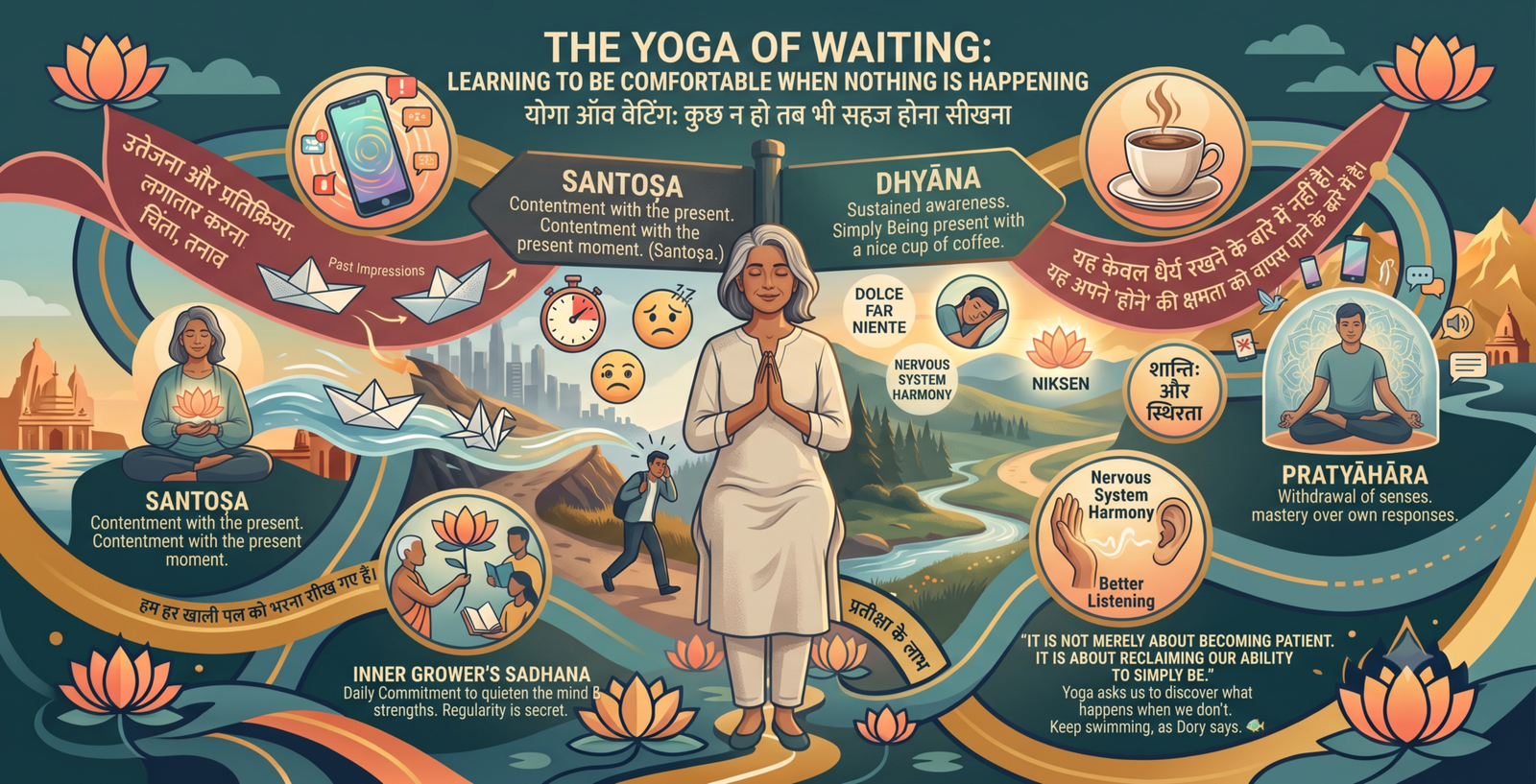
The Yoga of waiting is the practice of becoming comfortable with pauses, uncertainty and moments without immediate stimulation. Through principles such as Santoṣa (contentment), Pratyāhāra (withdrawal of the senses) and Dhyāna (sustained attention), Yoga offers a way to reduce our dependence on constant stimulation and develop greater presence, patience and self-regulation.
—
Why Has Waiting Become So Difficult?
Waiting is a normal part of human life.
We wait for people, opportunities, results, recovery, answers, journeys and change.
But modern technology has dramatically reduced our tolerance for waiting.
Most of us carry a small entertainment centre in our pockets. Whenever there is a pause, we can immediately fill it with information, conversation, entertainment or stimulation.
The problem is not the phone itself.
The problem is our automatic relationship with stimulation.
When every uncomfortable pause is immediately filled, we lose opportunities to experience silence, observe our thoughts and simply remain with what is happening.
Over time, we may begin to associate stillness with boredom and productivity with personal worth.
This can contribute to a lifestyle characterised by constant mental engagement, difficulty switching off and a feeling that we should always be doing something.
The ability to wait, therefore, is not merely a social skill.
It is also an opportunity to understand our relationship with our own mind.
—
The Art of Doing Nothing
Different cultures have explored this territory in their own ways.
The Italian expression dolce far niente is commonly translated as “the sweetness of doing nothing.” It points towards the enjoyment of simply being rather than constantly pursuing productivity.
The Japanese concept of Ma refers to meaningful space, intervals or pauses. It is often appreciated in architecture, art, music and everyday life.
The Dutch word niksen is commonly used to describe intentionally doing nothing or allowing oneself to be idle.
In Chinese philosophy, wú wéi is often translated as “non-doing,” although this can be misleading. It is better understood as action without unnecessary force or interference-acting in harmony with circumstances rather than constantly struggling against them.
These concepts arise from different cultural and philosophical backgrounds. They should not be treated as interchangeable.
Yet they point towards an interesting human capacity:
Can we experience a moment without immediately needing to fill it?
Indian Yoga philosophy approaches this question from another direction.
Three ideas are particularly relevant: Santoṣa, Pratyāhāra and Dhyāna.
—
Santoṣa: Contentment Without Passivity
Santoṣa is one of the Niyamas described in Patañjali’s Yoga tradition.
It is commonly translated as contentment.
But contentment does not mean abandoning ambition.
It does not mean refusing to improve our circumstances.
And it certainly does not mean becoming passive.
Rather, Santoṣa invites us to examine our constant dissatisfaction with what is already here.
We often live psychologically between two points:
“What happened?”
and
“What will happen?”
We replay the past or anticipate the future while missing the experience of the present.
Waiting provides a particularly good opportunity to observe this tendency.
Suppose you are waiting for an important message.
The external situation is simple: the message has not arrived.
But internally, the mind may create an entire story:
Why haven’t they replied?
Did something go wrong?
What if they don’t respond?
Maybe I should message again.
The waiting itself may last ten minutes.
The mental activity can last much longer.
Santoṣa does not necessarily change the external situation.
It changes our relationship with the situation.
—
Pratyāhāra: Breaking the Automatic Reach for Stimulation
Pratyāhāra is traditionally described as the withdrawal of the senses from their objects.
In practical modern life, we can understand one aspect of this as learning not to automatically follow every sensory invitation.
A notification appears.
We look.
A vibration occurs.
We check.
We feel bored.
We scroll.
We experience silence.
We search for something to fill it.
This creates a powerful habit loop.
Stimulus → impulse → response.
Pratyāhāra creates a small but important space between the two.
Stimulus → awareness → choice.
You still hear the notification.
You simply don’t have to respond immediately.
You still experience boredom.
You don’t have to escape it immediately.
You still have access to entertainment.
You simply become capable of choosing when to engage with it.
This is not rejection of the external world.
It is greater freedom in how we relate to it.
—
Dhyāna: Learning to Stay With One Experience
There is an important distinction here.
Dhyāna should not simply be equated with “doing nothing.”
In Yoga philosophy, Dhyāna refers to sustained meditative attention.
Its relevance to waiting lies in the ability to remain with an experience without constantly jumping towards another object.
Consider drinking a cup of coffee.
You could drink it while:
– answering messages,
– watching a video,
– checking notifications,
– thinking about tomorrow’s work,
– scrolling through social media.
Or you could simply drink the coffee.
Feel its warmth.
Notice its aroma.
Taste it.
Experience the movement of the mind.
Return to the experience.
Nothing extraordinary needs to happen.
The coffee does not need to become a meditation retreat.
But for a few minutes, you are not demanding additional stimulation from the moment.
This is the beginning of learning to stay.
—
What Happens When We Learn to Wait?
Learning to wait does not mean becoming slow or unproductive.
It means becoming less dependent on constant stimulation.
With regular practice, mindful pauses may support:
– better attentional control
– reduced impulsive reactions
– greater comfort with silence
– better awareness of emotional responses
– more deliberate communication
– improved listening
– greater presence with family and friends
– healthier boundaries around digital stimulation
– less automatic phone checking
– a healthier relationship with productivity
The important point is that these benefits do not come simply from “doing nothing.”
They come from how we relate to the moment while doing nothing.
—
A Simple Yoga Practice for Learning to Wait
You don’t need an hour of meditation to begin.
Try this simple 5-minute Waiting Practice once a day.
Step 1: Choose a natural waiting period
Use an ordinary situation:
– waiting for tea or coffee
– waiting for a lift
– waiting for a meeting
– waiting in a queue
– waiting for someone to arrive
Step 2: Keep your phone away
Don’t replace one activity with another.
Let the pause remain a pause.
Step 3: Notice the body
Observe your posture, breathing, facial tension and muscular activity.
Don’t try to immediately change anything.
Step 4: Observe the impulse
Notice the urge to check your phone, move, talk or find stimulation.
Simply recognise it.
Step 5: Return to the present
Bring attention to your breathing, sounds, surroundings or physical sensations.
The objective is not to stop thoughts.
The objective is to stop automatically following every thought or impulse.
Step 6: Stay for a little longer
If you can comfortably wait for two minutes today, try three minutes tomorrow.
You are gradually training your capacity to remain present without requiring constant stimulation.
—
Common Mistakes When Practising the Yoga of Waiting
1. Turning waiting into another productivity task
The purpose is not to become “better at doing nothing” so that you can become more productive later.
That defeats the point.
2. Trying to stop all thoughts
Thoughts will arise.
The practice is awareness, not mental suppression.
3. Forcing yourself to remain uncomfortable
Waiting should not become an exercise in unnecessary suffering.
Begin with ordinary, manageable situations.
4. Confusing stillness with inactivity
You can be physically still while the mind is extremely active.
The deeper practice is observing your relationship with that activity.
5. Expecting immediate results
The ability to remain present develops gradually, just like physical flexibility.
—
A Practical Example
Imagine that you are waiting for a friend who is ten minutes late.
The usual response might be:
Check the phone.
Send a message.
Check the phone again.
Open Instagram.
Read the news.
Send another message.
Become irritated.
By the time your friend arrives, the ten-minute wait has already influenced your emotional state.
Now imagine a different approach.
You notice the irritation.
You feel your breath.
You observe people around you.
You notice the impulse to check your phone.
You choose not to act on it immediately.
You allow the ten minutes to simply be ten minutes.
The external situation has not changed.
Your friend is still late.
But your relationship with the waiting has changed.
That is where the practice becomes meaningful.
—
A Quick Waiting Practice Checklist
– Leave a few minutes empty in your day.
– Avoid automatically reaching for your phone during pauses.
– Observe your breathing while waiting.
– Notice the urge for stimulation without immediately acting on it.
– Practice enjoying one ordinary activity without multitasking.
– Spend a few minutes each day without intentional entertainment.
– Practise listening without preparing your response.
– Allow occasional silence in conversations.
– Notice whether boredom actually needs to be solved.
– Let some moments simply remain unfinished.
—
Frequently Asked Questions
Is the Yoga of waiting an actual Yoga practice?
It is better understood as a practical application of Yogic principles rather than a formally named classical Yoga practice. Santoṣa, Pratyāhāra and Dhyāna offer useful philosophical and practical perspectives on our relationship with waiting and stimulation.
Does doing nothing mean being lazy?
No. Rest, silence and unstructured time are not automatically laziness. The distinction lies in intention and awareness.
What does Santoṣa mean in Yoga?
Santoṣa means contentment. It encourages a relationship with the present that is not dominated by constant dissatisfaction, while still allowing purposeful action and growth.
What is Pratyāhāra?
Pratyāhāra is traditionally described as the withdrawal of the senses from their objects. Practically, it can help us understand how to reduce automatic reactivity to sensory stimulation.
Is Dhyāna the same as doing nothing?
No. Dhyāna refers to sustained meditative attention. It involves a quality of continuous awareness rather than simply being inactive.
Why do I feel uncomfortable when I have nothing to do?
Constant stimulation can become habitual. When stimulation suddenly stops, the mind may immediately search for another object of attention.
Can waiting reduce stress?
Mindful waiting may help develop greater awareness and reduce automatic reactivity. It should not, however, be presented as a standalone treatment for chronic stress or anxiety.
How can I practise waiting with my phone?
Start with small periods. During a queue, for example, keep your phone away for two or three minutes and observe your surroundings and breathing.
How long should I practise?
There is no fixed requirement. Even a few mindful minutes each day can become a useful starting point.
Should I stop using social media?
Not necessarily. The objective is not rejection of technology but developing the freedom to choose when and how you use it.
Is boredom useful?
Boredom can become an opportunity to observe the mind before immediately seeking stimulation. It can also reveal how strongly we have become dependent on constant engagement.
Can waiting improve relationships?
It can support skills such as listening, patience and reduced reactivity. These qualities can positively influence communication.
The Deeper Lesson of Waiting
Perhaps the ability to wait is not merely about becoming patient.
Perhaps it is about recovering something we have gradually lost.
The ability to sit without reaching.
To listen without interrupting.
To drink coffee without checking notifications.
To walk without needing a podcast.
To stand in a queue without feeling that the time is being wasted.
To experience silence without immediately filling it.
We have become very good at filling every empty moment.
Yoga invites us to explore what happens when we don’t.
The goal is not to escape activity.
It is not to reject technology.
It is not to stop being ambitious.
It is to develop enough inner freedom that we can act when action is needed-and remain still when nothing needs to be done.
Waiting then becomes more than an unavoidable inconvenience.
It becomes a small daily laboratory for awareness.
And perhaps, in those seemingly empty moments, we discover something important:
“Nothing is happening outside. But something is happening within us.”
Start With One Pause Today
The next time you are waiting, don’t immediately reach for your phone.
Pause.
Breathe.
Notice.
Stay.
You may discover that the moment you were trying so hard to escape was never empty in the first place.
If you want to explore Yoga beyond physical postures, begin with one simple practice: create a few moments of intentional pause every day.
Through Yoga therapy, pranayama, meditation and Yoga Nidra, the deeper objective is not simply to make the body flexible or the mind calm.
It is to develop a more conscious relationship with life-knowing when to act, when to observe, and when to simply be.