Yoga Beyond the Mat: 5 Simple Practices for Demanding Days
Many yoga practitioners experience wonderful benefits through regular practice.
Physical strength, flexibility and stamina may improve. The mind may become clearer. We may notice a more positive attitude, greater emotional balance and stability, and a more harmonious flow of energy in everyday life.
But I always emphasize one key idea: consistent, mindful practice.
Yoga is not simply about completing a set of postures or practising for the sake of saying, “I did my yoga today.” Every movement, every breath and every pause can be approached with awareness.
When practice develops in this way, yoga gradually becomes more than something we do on the mat. It begins to influence how we respond to life itself.
What Can Yoga Teach Us When Life Becomes Stressful?
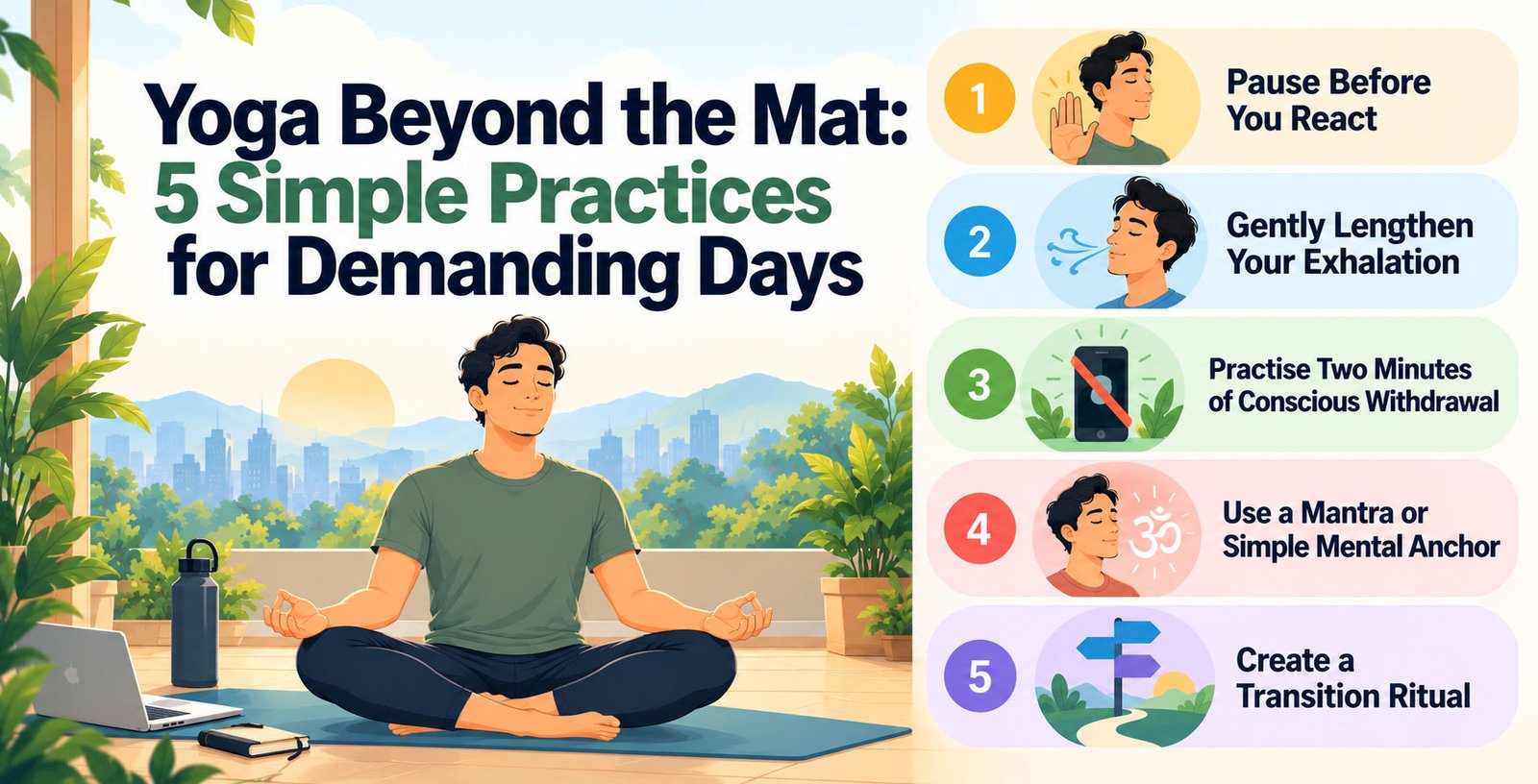
Yoga can be practised even in the middle of a demanding day- not necessarily through a full asana session, but through small moments of awareness. Pausing before reacting, lengthening the exhalation, withdrawing briefly from stimulation, using a mantra and creating conscious transitions can help us respond to stressful situations with greater steadiness.
Most of us understand what to do when we are on the yoga mat.
But what happens when we step off it?
What can we practise when work pressure is intense, the phone does not stop ringing, traffic tests our patience, responsibilities keep accumulating, or an unpleasant conversation leaves us irritated?
These are often the moments when yoga is needed the most.
The ancient science of yoga is not limited to physical postures. It offers practical principles that can be brought into ordinary situations- especially when we feel overwhelmed, frustrated, mentally tired or stressed.
Here are five simple practices that I encourage people to explore during demanding days.
1. Pause Before You React
One of the simplest practices is also one of the most difficult:
Do not react immediately.
When irritation rises or stress levels are already high, create a few seconds between what has happened and how you respond.
Observe yourself.
What is happening in the body?
Has your breathing become faster?
Are you angry, anxious or simply exhausted?
Do you really need to respond immediately?
Sometimes we speak or act not because the situation requires it, but because the mind wants instant release from its discomfort.
Instead, pause.
Take one conscious breath and ask yourself:
“Is a response necessary right now?”
If it is, respond more consciously.
If it is not, allow yourself to wait.
This small space between stimulus and response can become a powerful everyday yoga practice. It develops awareness and may prevent a temporary emotional state from turning into an unnecessary argument, message or decision.
Yoga is not only the ability to remain steady in an asana. It is also learning to remain aware when life itself becomes uncomfortable.
2. Gently Lengthen Your Exhalation
Stress often changes the way we breathe.
Without realizing it, breathing may become faster, shallower or more irregular. That is why bringing awareness back to the breath can be a useful way of interrupting the rush of a stressful moment.
Sit or stand comfortably.
Take a natural, comfortable inhalation through the nose and allow your exhalation to become slightly slower and longer.
There is no need to force the breath.
There is no competition.
There is also no need to hold the breath or chase a particular count.
Simply allow the exhalation to become smooth and comfortable.
Continue for around 3-5 minutes, provided it feels pleasant and effortless.
The purpose is not to achieve a particular breathing ratio. The purpose is to shift attention away from mental agitation and back toward a simple physiological process happening in the present moment.
This can be particularly useful before a difficult meeting, after an argument, during a demanding workday or whenever you notice that your mind is rushing ahead of you.
If you feel dizzy, uncomfortable or breathless, return immediately to normal breathing.
3. Practise Two Minutes of Conscious Withdrawal
We are surrounded by stimulation almost continuously.
Messages.
Notifications.
Conversations.
Screens.
News.
Work.
Noise.
Even when the body stops working, the senses may continue consuming information.
Sometimes the mind does not need another technique or another piece of advice.
It simply needs less input.
Put your phone aside for two minutes.
Stop unnecessary conversation.
Sit comfortably and, where appropriate, gently close your eyes.
Observe yourself without trying to analyse everything.
You may mentally suggest:
“Relax.”
“Let go.”
“For these two minutes, nothing needs to be solved.”
Relax the facial muscles, shoulders and abdomen. Allow accumulated tension to settle.
This can serve as a very simple practical introduction to Pratyahara, traditionally understood as withdrawal or drawing the senses inward.
You do not need perfect silence or a meditation room.
You are simply reducing external stimulation temporarily and allowing awareness to return inward.
Two minutes may appear insignificant, but when practised regularly during a demanding day, such conscious pauses can change the quality of the next hour.
4. Use a Mantra or Simple Mental Anchor
A stressed mind tends to move rapidly from one thought to another.
Instead of fighting every thought, give the mind one simple point of attention.
If mantra is already part of your practice, mentally repeat a familiar mantra such as Om.
Let the repetition be gentle rather than mechanical.
Listen internally to the sound and notice when the mind wanders. When it does, simply return to the mantra.
If mantra practice is not suitable for you, use a simple neutral mental anchor such as:
“Calm.”
“Steady.”
“Present.”
The particular word is less important than the quality of attention you bring to it.
You can practise this quietly while waiting for a meeting, sitting in a parked vehicle, taking a break from work or before entering a difficult conversation.
The intention is not to suppress thoughts or pretend that the stressful situation does not exist.
The practice simply gives the wandering mind somewhere steady to return.
5. Create a Transition Ritual
One overlooked source of stress is that we often carry one activity directly into another.
The meeting ends, but mentally we are still arguing about it.
Work finishes, but work continues in the mind at home.
We arrive home physically, yet mentally we are still in traffic.
Even leisure time becomes filled with unfinished conversations and responsibilities.
This is why I recommend creating a small transition ritual.
After finishing work, completing a commute or ending a difficult meeting, take two or three minutes before beginning the next activity.
You might:
– practise a few gentle yoga or chair-yoga stretches,
– roll the shoulders and release unnecessary muscular tension,
– take a few conscious breaths,
– sit quietly for a minute,
– or mentally acknowledge that one part of the day has finished.
You can tell yourself:
“That activity is complete. Now I move to the next.”
This simple acknowledgement creates a psychological boundary between experiences.
The aim is not to deny what happened earlier. If something genuinely requires action, you can return to it later.
The purpose is to prevent every stressful event from spilling unnecessarily into the rest of the day.
From Effortful Practice to Greater Effortlessness
These five practices are simple, but simplicity should not be confused with insignificance.
The real transformation comes through repetition.
At first, you may remember to pause only after you have reacted.
You may notice your breathing only after you have already become overwhelmed.
You may remember your mantra only after spending twenty minutes mentally replaying an argument.
That is perfectly natural.
Awareness develops through practice.
Over time, you may begin noticing the irritation while it is rising, the tension while it is accumulating, and the mental rush before it completely takes over.
This is where yoga begins moving beyond the mat.
In my experience of teaching yoga for nearly two decades, this is an important shift. A practitioner may develop impressive flexibility or strength, but the deeper question remains:
Is the practice helping us live with greater awareness?
That does not mean we will never become angry, stressed or frustrated.
Yoga does not make us immune to the demands of life.
It can, however, help us become more aware of how we meet those demands.
A Simple Yoga-Beyond-the-Mat Checklist
During a stressful day, remember these five steps:
1. Pause – Do I really need to react immediately?
2. Breathe – Can I gently soften and lengthen my exhalation?
3. Withdraw – Can I reduce stimulation for two minutes?
4. Anchor – Can I bring my mind to a mantra or one steady word?
5. Transition – Can I consciously complete this activity before entering the next?
You do not need to practise all five every time.
Choose what is appropriate for the situation.
The important thing is to practise consciously rather than mechanically.
Yoga Begins on the Mat- but It Does Not Have to End There
Consistent practice can develop strength, flexibility, stamina and greater awareness.
But perhaps one of the most meaningful applications of yoga is what happens when there is no yoga mat beneath us.
When somebody irritates us.
When work becomes intense.
When plans change unexpectedly.
When we are mentally exhausted.
When we are about to carry the stress of one moment into the next.
These situations become opportunities to practise.
Pause.
Breathe.
Withdraw for a moment.
Give the mind an anchor.
Complete one experience before carrying yourself into another.
With consistent and mindful practice, these simple techniques can help cultivate deeper awareness and gradually bring greater steadiness- and perhaps a little more effortlessness- into everyday life.
Yoga is not only about how consciously we practise on the mat. It is also about how consciously we meet life when we step off it.
Frequently Asked Questions
1. Can yoga help during a stressful workday?
Yoga does not have to mean doing a full asana session. Breath awareness, conscious pauses, brief sensory withdrawal, mantra repetition and gentle stretches can all be incorporated into an ordinary workday.
2. How long should I practise slow breathing?
Three to five minutes can be sufficient for a short practice. Keep the breathing comfortable and avoid forcing the inhalation or exhalation.
3. Should the exhalation always be longer than the inhalation?
Not necessarily. For this practice, simply allow the exhalation to become slightly slower and longer if that feels comfortable. Avoid straining to achieve a particular ratio.
4. What is Pratyahara?
Pratyahara is traditionally associated with withdrawing or turning the senses inward. In everyday life, consciously stepping away from unnecessary stimulation for a short period can offer a simple introduction to this principle.
5. Can I practise mantra mentally?
Yes. A familiar mantra can be repeated mentally as a point of attention. The emphasis should be on conscious repetition rather than mechanical repetition.
6. What if I do not practise mantra?
Use a neutral mental anchor such as “calm,” “steady” or “present,” or simply bring your attention to the natural breath.
7. What should I do when I become angry?
Before speaking or acting, pause briefly. Observe the breath and body and consider whether an immediate response is actually necessary.
8. Can these practices replace my regular yoga practice?
They are better viewed as an extension of regular practice. Your time on the mat develops awareness; these small practices provide opportunities to carry that awareness into everyday situations.
9. What is a transition ritual?
It is a brief conscious pause between two activities- for example, between work and home. A few stretches, conscious breaths or a moment of quiet can mark the completion of one activity before beginning another.
10. Which of these practices should I start with?
Start with the simplest: pause and take one conscious breath before reacting. Once this becomes familiar, gradually introduce the other practices into your day.