When Panic Strikes: Understanding Panic Attacks Through Yoga
The other day, a patient called me from the middle of a shopping mall.
“Sir, I am getting a panic attack.”
He did not know why it was happening. He could not identify any obvious trigger. He only knew that something felt terribly wrong.
The first thing I asked him to do was very simple:
Find a nearby chair and sit down.
Once he was seated, I guided him through grounding techniques and gentle breathing awareness. Gradually, the intensity reduced. Once he felt sufficiently settled and oriented, he was able to leave the mall and return home safely.
The incident was a reminder of how suddenly panic can arise, and how frightening it can feel when we do not understand what the body and mind are doing.
What Is a Panic Attack?
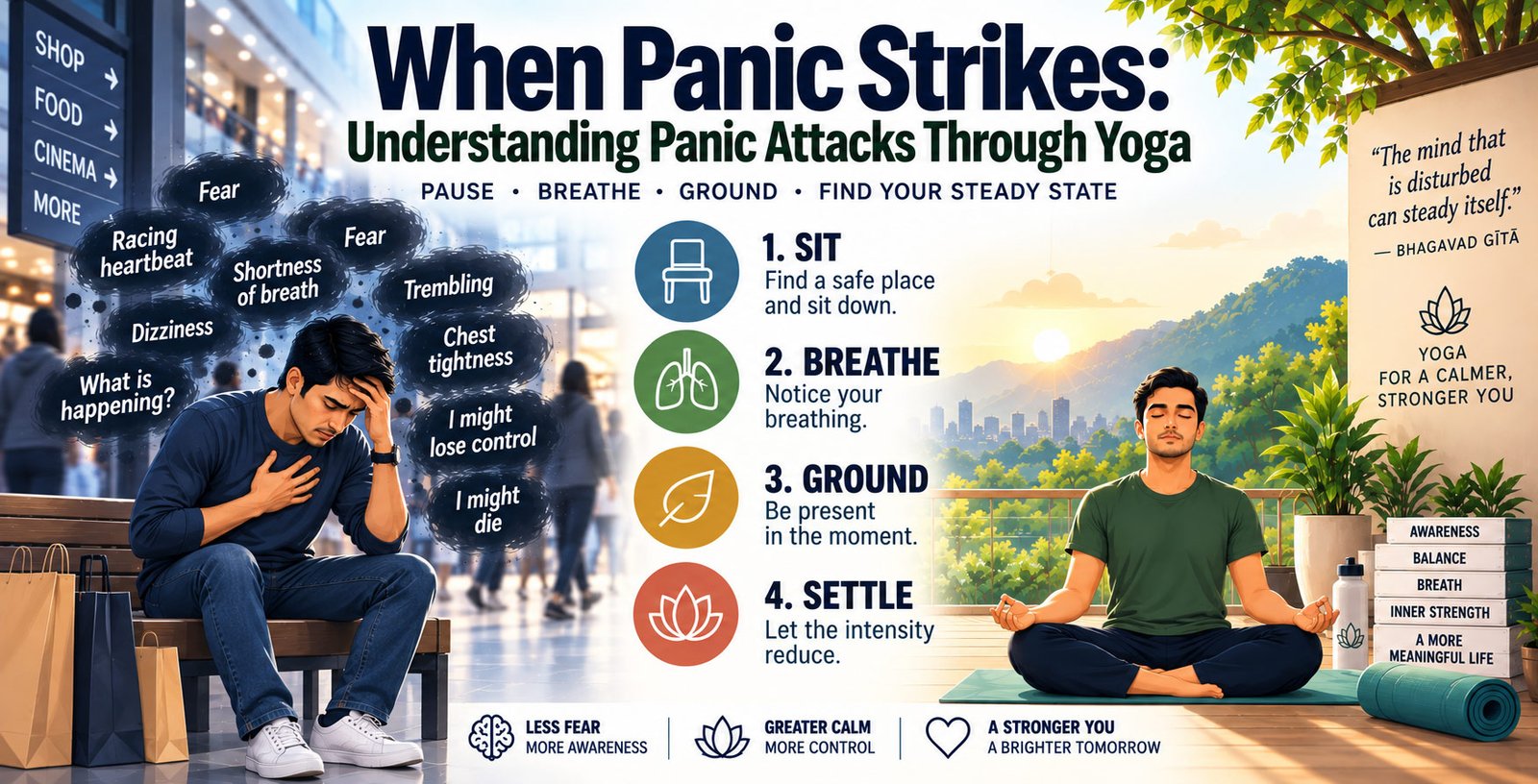
A panic attack is a sudden surge of intense fear or discomfort that usually reaches a peak within minutes. It can produce powerful physical and psychological symptoms even when there is no immediate external danger. Grounding, comfortable breathing and reassurance may help during an episode, while recurring attacks warrant professional assessment.
A person experiencing a panic attack may notice:
- Racing or pounding heartbeat
- Rapid or uncomfortable breathing
- Sweating
- Trembling or shaking
- Dizziness or light-headedness
- Tightness or discomfort in the chest
- Nausea
- Tingling sensations
- Feelings of unreality or detachment
- Fear of losing control
- Fear of dying
Sometimes there is an identifiable trigger. At other times, the person may not be consciously aware of what triggered the episode.
A common panic cycle can look like this:
Trigger- real, perceived or unclear → frightening interpretation → increased fear → stronger bodily sensations → further frightening interpretation → more panic
This is important because the bodily sensations themselves may become part of the perceived threat.
A racing heart produces fear.
That fear increases the heart rate.
Rapid breathing produces light-headedness.
The light-headedness creates more fear.
The cycle reinforces itself.
A Yogic Perspective on Panic and Distress
Traditional Yoga scriptures did not describe a “panic attack” as a modern psychiatric diagnosis. We should therefore be careful not to impose contemporary diagnoses retrospectively on scriptural figures.
However, yogic texts contain remarkably detailed observations of fear, mental disturbance, bodily trembling and changes in breathing.
One powerful example appears at the beginning of the Bhagavad Gītā.
Arjuna’s Moment of Overwhelming Distress
When Arjuna sees his relatives, teachers, elders and loved ones standing on the opposite side of the battlefield, he experiences profound psychological and physical distress.
He says:
वेपथुश्च शरीरे मे रोमहर्षश्च जायते ॥
गाण्डीवं स्रंसते हस्तात्त्वक्चैव परिदह्यते ।
न च शक्नोम्यवस्थातुं भ्रमतीव च मे मनः ॥
निमित्तानि च पश्यामि विपरीतानि केशव ।
न च श्रेयोऽनुपश्यामि हत्वा स्वजनमाहवे ॥
Vepathuś ca śarīre me roma-harṣaś ca jāyate
Gāṇḍīvaṁ sraṁsate hastāt tvak caiva paridahyate
Na ca śaknomy avasthātuṁ bhramatīva ca me manaḥ
Nimittāni ca paśyāmi viparītāni Keśava
Na ca śreyo ’nupaśyāmi hatvā sva-janam āhave.
“My whole body shudders; my hair stands on end. My bow, Gāṇḍīva, slips from my hand, and my skin burns. I am unable to remain steady, and my mind seems to whirl in confusion. O Keshava, I see adverse signs, and I see no good in killing my own people in battle.”
Arjuna’s experience should not be retrospectively diagnosed as a clinical panic attack.
Yet notice the description:
Trembling → intense bodily sensations → inability to remain steady → mental confusion → overwhelming perception of threat.
What makes these verses relevant to Yoga therapy is not a diagnostic label. It is their recognition of something deeply human: what the mind perceives can profoundly influence what the body experiences.
Patañjali on the Mind, Body and Breath
Patañjali provides another useful framework.
Yoga Sūtra 1.31 states:
दुःखदौर्मनस्याङ्गमेजयत्वश्वासप्रश्वासा विक्षेपसहभुवः॥
Duḥkha-daurmanasyāṅgamejayatva-śvāsa-praśvāsā vikṣepa-sahabhuvaḥ.
The terms include:
- Duḥkha: suffering or distress
- Daurmanasya: mental distress or dejection
- Aṅgamejayatva: trembling or instability of the body
- Śvāsa: disturbed inhalation
- Praśvāsa: disturbed exhalation
- Vikṣepa: distraction or disturbance
- Sahabhuvaḥ: accompanying symptoms
Again, Patañjali was not defining the modern diagnosis of a panic attack.
But the relationship he identifies is highly relevant: mental disturbance may be accompanied by bodily instability and disturbed breathing.
From a practical Yoga-therapy perspective, we can therefore view an acute episode as a temporary loss of steadiness across three interconnected dimensions:
Śarīra (body) → Śvāsa (breath) → Manas (mind) → Steadiness
The immediate goal is not to fight the panic.
It is to gradually re-establish steadiness.
What Can You Do During a Panic Attack?
During an acute episode, this is not the time for complicated Yoga techniques or demanding breath control.
Think:
Ground first. Breathe comfortably. Orient yourself. Allow the intensity to pass.
1. Sit Down and Establish Physical Support
If possible, sit somewhere safe.
Place both feet comfortably on the floor.
Notice:
- Feet touching the ground
- Thighs supported by the chair
- Back touching the support
- Hands resting on the thighs
Relax the jaw, shoulders and abdomen as much as comfortably possible.
Sometimes, during acute distress, a simple chair is more useful than an elaborate āsana.
2. Use Slow, Comfortable Breathing
Rather than immediately trying to “take a deep breath,” first notice your natural breathing.
If comfortable, place one hand gently over the abdomen and feel its movement.
Gradually allow the breathing to become quieter and easier. If it feels natural, make the exhalation slightly longer than the inhalation—for example:
Inhale: approximately 4 seconds
Exhale: approximately 6 seconds
Continue comfortably for a few minutes.
Do not force the rhythm.
Very large or repeated forceful inhalations can contribute to over-breathing and may worsen light-headedness in some people.
3. Try the 5–4–3–2–1 Grounding Method
Shift attention from frightening internal sensations towards the environment.
Identify:
- 5 things you can see
- 4 things you can touch or physically feel
- 3 things you can hear
- 2 things you can smell
- 1 thing you can taste
The purpose is not to suppress the experience.
The purpose is to bring awareness back to what is actually present here and now.
4. Use Gentle Bhrāmarī-Only If Comfortable
For someone already familiar and comfortable with Bhrāmarī, a gentle version may be calming.
Take an easy inhalation and produce a soft humming sound during the exhalation.
Around 11 comfortable rounds may be sufficient initially.
Avoid breath retention (kumbhaka) during an acute episode.
Most importantly, if humming or focusing on the breath increases anxiety, stop the practice and return to external grounding.
Yoga therapy must adapt to the person-not force the person to adapt to a technique.
5. Reassure and Reorient
A few simple statements can help:
- “I am here.”
- “I am safe in this moment.”
- “This sensation will rise and pass.”
- “I can allow my breathing to settle.”
Look around.
Notice where you are.
Feel the ground beneath your feet.
Identify familiar objects around you.
This helps shift attention from perceived or imagined danger towards the reality of the present environment.
What Should Be Avoided During Acute Panic?
During an acute episode, avoid turning Yoga into another challenge for the nervous system.
Generally avoid:
- Kapālabhāti
- Bhastrikā
- Rapid breathing techniques
- Prolonged kumbhaka
- Forceful deep breathing
- Strenuous āsanas
- Complicated breathing ratios
- Forcing someone to close their eyes if that makes them uncomfortable
Once the episode has settled, appropriate restorative postures such as supported Supta Baddha Koṇāsana, Śaśāṅkāsana, Jathara Parivartanāsana or Matsyakrīḍāsana may be considered according to the individual’s comfort and condition.
The principle remains simple:
During panic, the goal is not performance. The goal is regulation.
A Simple Yoga-Therapy Framework for Panic
When someone becomes overwhelmed, remember:
1. Stabilise the body
Sit or stand somewhere safe and establish physical support.
2. Orient to the environment
Use the senses to reconnect with the present moment.
3. Allow breathing to settle
Do not force deep breathing. Encourage comfortable, unhurried respiration.
4. Reduce the sense of threat
Use simple reassurance rather than arguing with the person’s fear.
5. Observe the response
If symptoms settle, continue gently. If symptoms are severe, unusual or medically concerning, seek appropriate medical help.
From Panic to Steadiness
One of Yoga’s valuable insights is that body, breath and mind do not function independently.
A frightened mind can alter breathing.
Disturbed breathing can intensify bodily sensations.
Those bodily sensations can then frighten the mind further.
The cycle can therefore move in both directions.
This is why, when someone is overwhelmed by panic, we do not necessarily have to begin by telling them to “control their thoughts.”
Sometimes we begin somewhere much simpler.
Sit down.
Feel the ground.
Notice the breath.
Look around.
Allow the body to settle.
Śarīra → Śvāsa → Manas.
Gradually, steadiness may return.
When Should You Seek Professional Help?
Yoga can be a valuable supportive tool, but recurring panic attacks should not simply be self-managed indefinitely.
Consider professional medical or mental-health assessment if attacks:
- Occur repeatedly
- Appear unexpectedly
- Lead to persistent fear of another attack
- Cause avoidance of malls, travel, crowds, work or social situations
- Interfere with sleep, relationships or daily functioning
- Become increasingly severe
Panic disorder and other anxiety conditions are treatable, and some physical health conditions can produce symptoms that resemble anxiety or panic.
New or severe chest pain, fainting, severe breathlessness, neurological symptoms, or symptoms significantly different from a person’s usual panic episodes require prompt medical assessment rather than being automatically attributed to anxiety.
Frequently Asked Questions
Can Yoga stop a panic attack immediately?
No technique can be guaranteed to stop an attack immediately. Grounding, comfortable breathing, reassurance and sensory orientation may help reduce escalation and support a return towards steadiness.
Is deep breathing good during a panic attack?
Gentle breathing can help, but forcefully taking repeated large breaths is not always useful. Comfortable, unforced breathing is generally a better starting point.
Is Bhrāmarī useful during panic?
Some people find gentle humming calming. Others become more anxious when attention is directed towards breathing. Use it only when comfortable and discontinue it if symptoms worsen.
Should I practise Kapālabhāti during a panic attack?
Rapid or forceful breathing practices are generally inappropriate during an acute panic episode. The immediate priority is regulation rather than stimulation.
Can I practise kumbhaka during panic?
Prolonged or forceful breath retention is best avoided during an acute episode.
Which Yoga posture is best during panic?
Often the simplest option is sitting safely in a supported chair with both feet on the floor. More elaborate postures are not necessary during the acute phase.
Why does grounding help?
Grounding redirects attention towards immediate sensory information and the present environment rather than allowing attention to remain entirely absorbed in frightening internal sensations.
Can panic attacks happen without an obvious trigger?
Yes. Sometimes a person cannot identify an immediate trigger, which can make the experience even more frightening.
Does the Bhagavad Gītā describe a panic attack?
The Bhagavad Gītā describes Arjuna experiencing intense psychological and bodily distress, but it would be inappropriate to retrospectively diagnose him with a modern clinical condition.
Does Patañjali discuss anxiety?
Patañjali describes mental disturbances and associated manifestations such as distress, bodily trembling and disturbed inhalation and exhalation. These concepts can inform a yogic understanding of mind-body interaction, but they are not identical to modern psychiatric diagnoses.
Can Yoga cure panic disorder?
Yoga may be a useful complementary practice for stress regulation and self-awareness, but panic disorder deserves appropriate professional assessment and evidence-based treatment. Yoga should complement necessary healthcare rather than replace it.
The Essential Reminder
When panic strikes, we often want to immediately control the mind.
Yoga offers another possibility.
Start with what is tangible.
Feel the body.
Feel the ground.
Allow the breath to settle.
Return awareness to the present.
The mind may gradually follow.
Śarīra → Śvāsa → Manas → Sthiratā.
From disturbance towards steadiness.
If you experience recurring anxiety or panic and would like to explore an individualised Yoga-therapy approach involving breath awareness, relaxation, grounding and mind-body practices, professional guidance can help determine which practices are appropriate for you.
Yoga practices discussed here are educational and supportive in nature and are not a substitute for medical or mental-health diagnosis or treatment.
Experiencing recurring stress, anxiety or panic-like episodes?
Explore Yoga therapy as a complementary approach to developing greater awareness of the body, breath and mind. Individual practices should be selected according to your needs, health condition and response rather than following a one-size-fits-all routine.
Athatoyoga — Yoga beyond the posture.