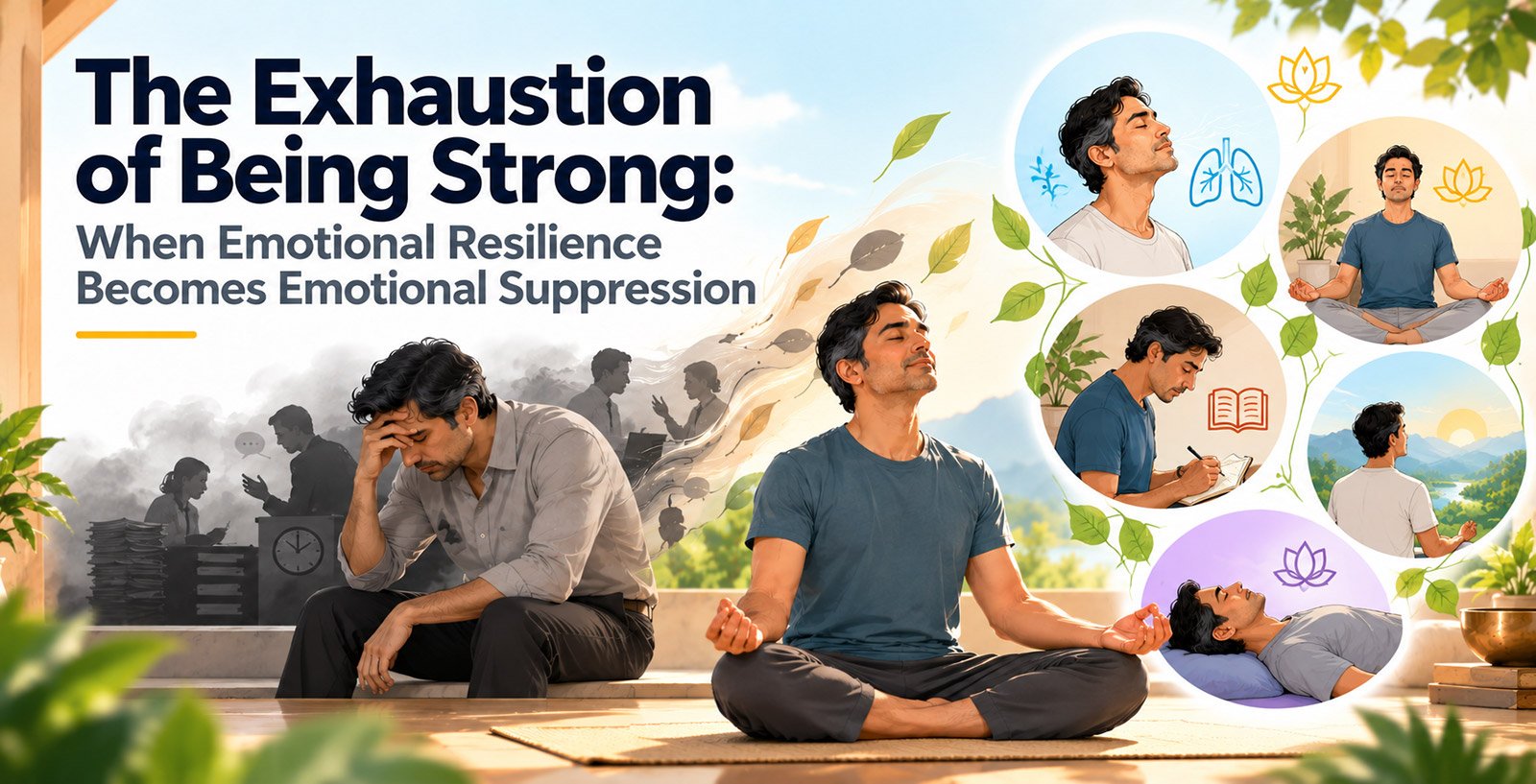
The Exhaustion of Being Strong: When Emotional Resilience Becomes Emotional Suppression
Sometimes, the people who appear strongest on the outside are the ones silently struggling the most within.
“You know, Omkar Sir, I am tired of being strong every time.”
He could barely complete the sentence before breaking down in tears.
The man sitting before me was in his forties. He had not approached me with a complicated health problem. Instead, he was deeply disturbed by an incident at his workplace.
A minor disagreement over adjusting the office air-conditioning temperature had triggered an unexpectedly loud and emotional reaction from him.
What made the incident unusual was his reputation. For years, he had been known as one of the most disciplined, humble, responsible, and composed employees in his organization.
Yet something as ordinary as an AC temperature adjustment had disturbed his emotional balance.
During our counseling conversation, a deeper pattern gradually emerged.
For years, he had been suppressing his feelings, avoiding disagreements, and prioritizing the comfort and expectations of others, sometimes even complete strangers.
He had become so accustomed to accommodating everyone else that he had almost forgotten how to acknowledge his own emotional needs.
His outburst was not simply about the temperature of the room. It appeared to reflect years of unexpressed feelings and accumulated emotional strain.
And his story raises an important question:
How often do we mistake emotional suppression for emotional strength?
What Happens When Emotional Resilience Becomes Emotional Suppression?
Emotional resilience is the ability to recognize, manage, and recover from difficult emotions while adapting to life’s challenges. Emotional suppression, on the other hand, involves repeatedly hiding or inhibiting emotional expression without necessarily addressing the underlying feelings. When suppression becomes habitual, it may contribute to emotional exhaustion, irritability, disconnection, and psychological distress.
The Hidden Cost of Always Being Strong
There is an unfortunate tendency among many people to hide their feelings in the name of maturity, responsibility, or maintaining relationships.
Consider a familiar situation.
You want to say No, but you say Yes because you do not want to disappoint someone.
You disagree with a decision, but remain silent to avoid confrontation.
You feel hurt, but convince yourself that expressing it would be inappropriate.
You are exhausted, yet continue fulfilling everyone else’s expectations because you believe you must always remain dependable.
Initially, these choices may appear insignificant. However, when repeated over months and years, they can become an unconscious behavioural pattern.
Gradually, prioritizing others at the expense of one’s own emotional well-being becomes a way of life.
The person may begin to believe that expressing disappointment is weakness, setting boundaries is selfishness, and asking for emotional support is a sign of inadequacy.
Unfortunately, society sometimes reinforces these beliefs by praising people who never complain, never refuse, and never appear emotionally disturbed.
But being emotionally mature does not mean becoming emotionally invisible.
When emotional suppression becomes a habit
Over time, habitual emotional suppression may contribute to:
* Persistent inner irritation and resentment.
* Emotional fatigue despite adequate physical rest.
* Reduced enthusiasm for previously enjoyable activities.
* Difficulty recognizing and expressing personal needs.
* Feelings of loneliness, even while surrounded by people.
* Increased emotional reactivity to seemingly minor situations.
Some individuals may also experience symptoms of anxiety or depression, although emotional suppression alone does not establish a clinical diagnosis.
Life may gradually begin to feel mechanical.
Responsibilities continue, routines are maintained, and expectations are fulfilled, but the individual may lose touch with the simple beauty and joy of everyday living.
This is why it is essential to distinguish between emotional regulation and emotional suppression.
Emotional Regulation vs. Emotional Suppression: Understanding the Difference
Emotional regulation does not mean expressing every feeling impulsively. Nor does it mean preventing uncomfortable emotions from arising.
It involves becoming aware of an emotion, understanding its influence, and choosing an appropriate response.
| Emotional Suppression | Emotional Regulation |
|---|---|
| Hiding feelings to avoid discomfort | Acknowledging feelings with awareness |
| Avoiding difficult conversations | Communicating emotions appropriately |
| Ignoring personal emotional needs | Recognizing and respecting personal needs |
| Maintaining outward calm at any cost | Developing inner stability and flexibility |
| Allowing unresolved feelings to accumulate | Processing emotions constructively |
The essential difference is awareness.
A person practicing emotional regulation may still choose silence, but that silence comes from understanding rather than fear.
Similarly, expressing anger does not necessarily mean losing emotional control. One can communicate dissatisfaction firmly without aggression.
True emotional strength is not the absence of emotions. It is the ability to remain aware of them without becoming overwhelmed or controlled by them.
Understanding Emotional Exhaustion Through the Five Kleśas of Yoga
Yogic philosophy offers a valuable framework for examining the psychological patterns that contribute to suffering.
In the Yoga Sūtras, Maharṣi Patañjali describes five Kleśas, or fundamental afflictions, that influence human perception, attachment, behaviour, and suffering.
Although these concepts were not originally formulated as a modern psychological theory of emotional suppression, they offer meaningful insights into how we relate to our emotions.
- Avidyā – Ignorance or Misunderstanding
Avidyā involves a fundamental misunderstanding of reality and our true nature.
In everyday emotional life, it may appear when we confuse suppression with strength or believe that remaining silent is always a sign of maturity.
We may fail to recognize that acknowledging vulnerability is sometimes essential for psychological well-being.
- Asmitā – Ego-Identification
Asmitā involves identification with the sense of I.
A person may become deeply attached to an identity such as:
“I am the strong one.”
“I must always remain responsible.”
“Everyone depends on me.”
When this identity becomes rigid, expressing sadness, uncertainty, or exhaustion may feel like a personal failure.
The individual begins protecting the image of being strong rather than responding honestly to inner experience.
- Rāga – Attachment
Rāga refers to attachment arising from pleasurable experiences.
In relationships, it may manifest as excessive dependence on appreciation, approval, affection, or acceptance.
We may repeatedly compromise our own emotional needs because we fear disappointing others or losing their approval.
- Dvesa – Aversion
Dvesa refers to aversion arising from unpleasant experiences.
Emotionally, it may appear as resistance to sadness, fear, disappointment, rejection, or difficult conversations.
Instead of understanding uncomfortable emotions, we attempt to push them away.
Yet avoiding an emotion does not necessarily resolve the experience that produced it.
- Abhiniveśa – Clinging to Life
Traditionally, Abhiniveśa refers to the deep instinctive clinging to life and fear of death.
In a broader reflective application, it can also encourage us to examine our fear of losing control, certainty, or familiar identities.
Someone who has always been perceived as emotionally strong may find it frightening to reveal vulnerability.
Together, these five Kleśas provide a framework for examining the attachments, misconceptions, and fears that influence our emotional responses.
Yoga encourages us to recognise these patterns through awareness, self-study, and disciplined practice.
The purpose is not to eliminate emotions but to develop a healthier and more conscious relationship with them.
Five Practical Yogic Techniques to Manage Emotional Exhaustion
Understanding our emotional patterns is important, but understanding alone may not change deeply established habits.
Consistent practice is equally necessary.
The following five Yogic approaches can help cultivate emotional awareness, relaxation, and a more balanced response to everyday challenges.
- Mauna – Conscious Silence
SUGGESTED PRACTICE: 30–60 MINUTES
Mauna is the practice of intentional silence.
Unlike emotional suppression, Mauna is not about forcibly withholding feelings. It is about creating an opportunity to observe the mind without immediately reacting to every thought or impulse.
How to practice:
Find a quiet period during your day when you can remain undisturbed.
Keep your phone, television, and other gadgets away. Sit comfortably and allow yourself to become still.
Observe your thoughts, feelings, impulses, and emotional reactions.
If an urge to speak, respond, or distract yourself arises, simply notice it.
You do not need to act upon every impulse.
Allow it to arise and pass naturally.
Begin with shorter periods if necessary, gradually extending the practice towards 30–60 minutes.
Mauna can help you recognize how frequently the mind seeks external stimulation and how difficult it may initially feel to remain quietly with yourself.
The objective is not to silence emotions but to become comfortable observing them.
- Vairāgya – Non-Attachment
DAILY PRACTICE: 3 MINUTES
Vairāgya teaches us to reduce excessive attachment to expectations, outcomes, emotional dependencies, and the need for approval.
It does not mean becoming indifferent towards people or responsibilities.
Rather, it encourages us to perform our duties sincerely without making our emotional peace entirely dependent on others’ responses.
A simple daily practice:
At the end of each day, sit quietly and reflect on three aspects.
Observe: What expectation, attachment, or desire for approval disturbed my peace today?
Accept: Can I acknowledge the emotion without judging or suppressing it?
Release: Remind yourself:
“I can give my best without controlling the outcome or how others respond.”
With consistent reflection, Vairāgya may help develop greater emotional independence and flexibility.
3. Svādhyāya – Self-Reflection
DAILY PRACTICE: 3-5 MINUTES
Svādhyāya, one of the Niyamas in Yogic philosophy, involves self-study and reflection.
Many people move through their days without consciously examining what they feel or why they react in particular ways.
Svādhyāya offers an opportunity to recognise recurring emotional patterns and unmet needs.
A simple daily practice:
Observe: What emotions and thoughts dominated my day?
Reflect: What triggered these emotions, and how did I respond?
Learn: What can I understand about myself, and what could I approach differently tomorrow?
For example, if you felt irritated after agreeing to an unwanted responsibility, reflect on whether the irritation arose from the task itself or from your difficulty in saying No.
Such reflections can reveal patterns that otherwise remain unnoticed.
Observe without judgement. Understand without criticism. Grow through awareness.
4. Conscious Breathing – Regulating the Stress Response
DAILY PRACTICE: 3 MINUTES
Breathing provides a practical connection between bodily sensations and mental activity.
Gentle, comfortable breath regulation may support relaxation and reduce physiological arousal associated with stress.
A simple breathing practice:
Sit comfortably with your spine naturally upright and shoulders relaxed.
Observe: Notice your natural breathing without attempting to change it.
Regulate: Gently inhale for approximately four counts and exhale for six counts, without strain.
Relax: Continue for around three minutes, allowing the breath to remain smooth and comfortable.
If the counting feels uncomfortable, return to your natural breathing rhythm.
Avoid forcing the breath or holding it unnecessarily.
The intention is not to control every emotion through breathing but to create enough physiological calm to respond more consciously.
5. Yoga Nidrā – Deep Conscious Relaxation
SUGGESTED PRACTICE: 30–40 MINUTES
Yoga Nidrā is a systematic practice of guided conscious relaxation, traditionally performed in Śavāsana.
During the practice, awareness is gently directed through different parts of the body, sensations, and other elements of the guided process.
It offers an opportunity to release unnecessary muscular tension and experience deep rest while maintaining a degree of awareness.
How to practice:
Lie comfortably in Śavāsana in a quiet environment.
Follow a suitable guided Yoga Nidrā practice, allowing attention to move through the body without forcing concentration.
Remain receptive to the instructions and avoid judging your experience.
A session of approximately 30-40 minutes can provide a meaningful period of conscious rest, although shorter sessions may also be useful.
Yoga Nidrā may support relaxation and stress management, but it should not be considered a replacement for adequate sleep or professional mental healthcare when needed.
Common Mistakes While Developing Emotional Strength:
One common misunderstanding is that becoming emotionally resilient means never feeling disturbed.
Another is believing that every emotion must be expressed immediately.
Neither extreme is helpful.
Emotional maturity involves understanding when to express, when to reflect, when to establish boundaries, and when to allow an emotion to settle before responding.
Similarly, Vairāgya should not become emotional indifference, Mauna should not become avoidant of necessary conversations, and Svādhyāya should not turn into excessive self-criticism.
Yogic practices are most beneficial when approached with patience, consistency, and sensitivity towards individual needs.
A Simple Daily Checklist for Emotional Awareness
Before ending your day, ask yourself:
* Did I acknowledge my emotions rather than automatically dismissing them?
* Did I agree to something against my wishes merely to please someone?
* Did I communicate my needs respectfully?
* Did I allow myself a few moments of conscious breathing or silence?
* Did I give myself permission to rest without guilt?
You do not need to answer every question positively.
The purpose is to develop awareness, not create another set of expectations to fulfill.
Frequently Asked Questions
- What is emotional suppression?
Emotional suppression involves inhibiting the outward expression of feelings. When used habitually without addressing underlying emotions, it may contribute to psychological distress.
- Is emotional suppression the same as emotional resilience?
No. Emotional resilience involves adapting to challenges and recovering from difficult experiences, whereas suppression focuses on limiting emotional expression.
- Why do emotionally strong people sometimes feel exhausted?
People who consistently priorities responsibilities, avoid expressing personal needs, or feel compelled to remain dependable may experience accumulated emotional strain.
- Can emotional suppression lead to anger?
Habitual suppression may be associated with irritability or emotional reactivity in some individuals, although anger can have many different causes.
- How can Yoga help with emotional exhaustion?
Yogic practices such as Svādhyāya, conscious breathing, and Yoga Nidrā may support self-awareness, relaxation, and healthier responses to stress.
- What are the five Kleśas in Yoga?
The five Kleśas described by Patañjali are Avidyā, Asmitā, Rāga, Dveṣa, and Abhiniveśa. They represent fundamental sources of suffering in classical Yoga philosophy.
- What is the difference between Mauna and emotional suppression?
Mauna is intentional silence practised with awareness. Emotional suppression involves inhibiting emotional expression, often without fully processing the feelings involved.
- How does Vairāgya support emotional balance?
Vairāgya encourages reduced attachment to outcomes, approval, and expectations, helping individuals respond with greater emotional flexibility.
- Can three minutes of conscious breathing make a difference?
A short period of gentle breathing may help some people feel calmer. Regular practice can also encourage awareness of stress-related bodily responses.
When should someone seek professional help for emotional exhaustion?
Professional support is advisable when emotional distress persists, affects daily functioning, disrupts relationships or sleep, or is accompanied by significant anxiety or depressive symptoms.
Returning to the man who sat before me, his tears revealed something that his outwardly disciplined personality had concealed for years.
He had learned how to fulfil responsibilities, accommodate others, and maintain composure.
But somewhere along the way, he had neglected the equally important responsibility of acknowledging his own emotional needs.
His experience reminds us that emotional strength cannot be measured merely by how much discomfort we tolerate without complaint.
Sometimes, strength means saying No.
Sometimes, it means admitting that we are hurt.
Sometimes, it means expressing disappointment without guilt.
And sometimes, it simply means accepting that we are tired and need rest.
Yoga offers us an opportunity to move beyond the constant struggle of controlling or hiding our emotions.
Through awareness, reflection, non-attachment, conscious breathing, and relaxation, we can gradually learn to experience emotions without becoming overwhelmed by them.
“True emotional strength is not the ability to suppress what we feel, but the awareness to understand our emotions, the courage to express them, and the wisdom to know when to rest.”
At Athato Yoga, the emphasis is not merely on practicing Yoga on the mat, but on bringing Yogic wisdom into the way we understand ourselves, manage our emotions, and respond to everyday life.
Because sometimes, the most courageous thing a strong person can say is:
“I am tired, and I need to take care of myself too.”