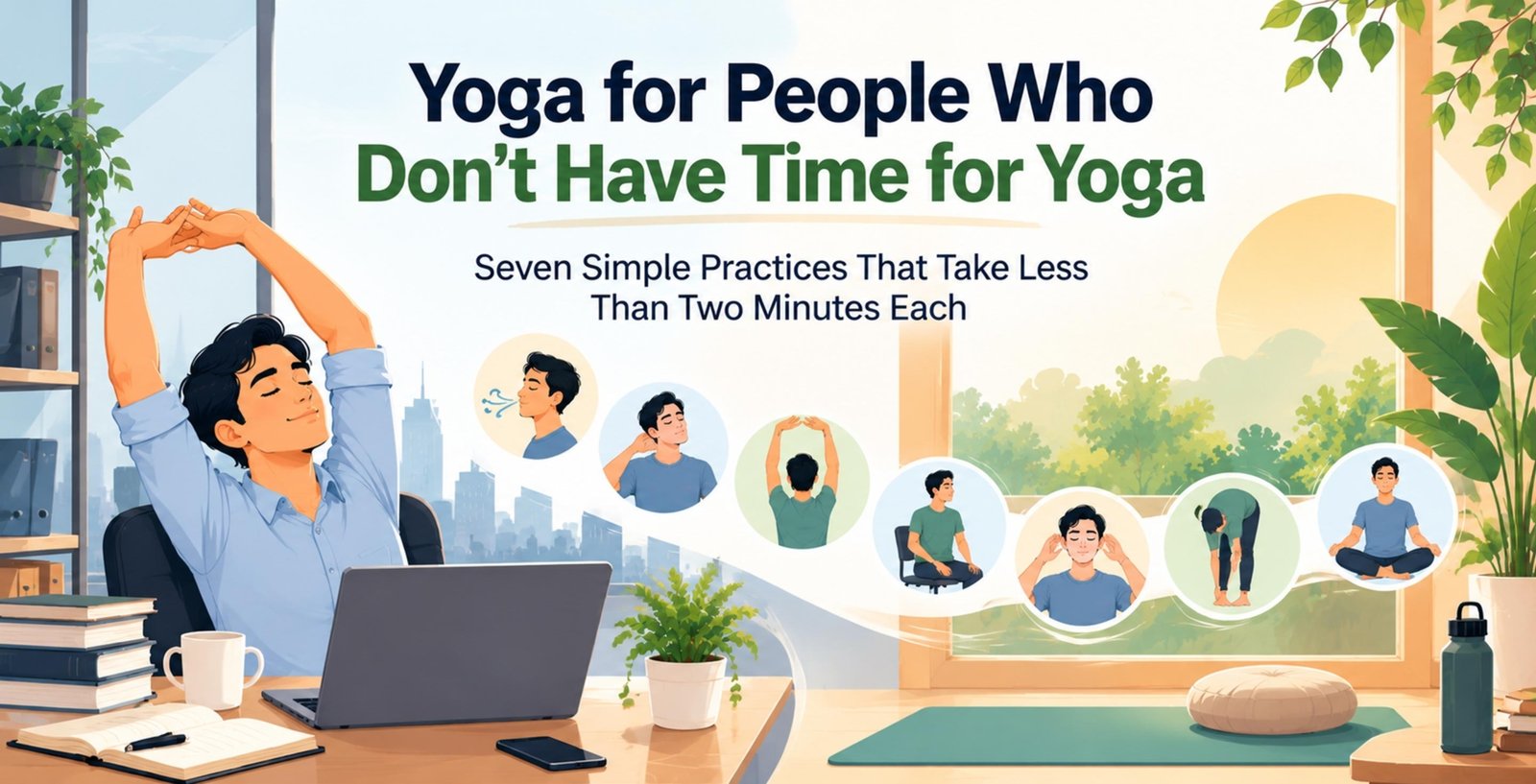
Yoga for People Who Don’t Have Time for Yoga
Seven Simple Practices That Take Less Than Two Minutes Each
There are days when even finding fifteen minutes for ourselves feels like a luxury.
Between demanding work schedules, professional responsibilities, family commitments, and the endless demands of everyday life, finding time to practise yoga on the mat can become challenging.
For dedicated practitioners, missing regular practice can feel discouraging. For beginners, the idea of setting aside an entire hour may become a barrier to getting started.
But does practising yoga always require a mat, a dedicated space, or an uninterrupted hour?
Not necessarily.
Yoga is not merely about performing physical postures or exhausting ourselves through demanding routines. Its deeper purpose is to cultivate awareness across the physical, energetic, mental, emotional, social, and spiritual dimensions of our existence.
And awareness does not depend on how much free time we have.
Can You Practise Yoga When You Have No Time?
Yes. Yoga for busy people can begin with simple practices lasting less than two minutes. Conscious breathing, gentle stretches, spinal movements, Bhrāmarī Prāṇāyāma, mindful pauses, and brief relaxation can help develop awareness, ease everyday tension, and maintain a connection with yoga even during demanding schedules.
The important thing is not the duration of every practice, but the quality of attention we bring to it.
Why Short Yoga Practices Matter
One of the biggest misconceptions about yoga is that a meaningful practice must always be long, physically demanding, or performed in a particular setting.
A structured yoga session certainly has its value. It allows us to explore Āsana, Prāṇāyāma, relaxation, and meditation in greater depth.
However, yoga need not disappear from our lives simply because we cannot attend a complete session.
A minute of conscious breathing between meetings, a gentle spinal movement after prolonged sitting, or a mindful pause before responding to a difficult situation can become an opportunity to practise yoga.
These small practices can help us:
– Maintain consistency during busy periods.
– Develop greater awareness of the body and breath.
– Interrupt prolonged periods of physical inactivity.
– Recognise accumulated mental and emotional tension.
– Create brief opportunities for relaxation.
– Bring yogic awareness into everyday activities.
Short practices are not necessarily replacements for comprehensive yoga sessions. Rather, they serve as practical bridges between formal practice and daily living.
Seven Simple Yoga Practices for Busy People
Here are seven accessible practices that can be performed individually in approximately one to two minutes. Most require no special equipment, and several can be practised while sitting at your desk.
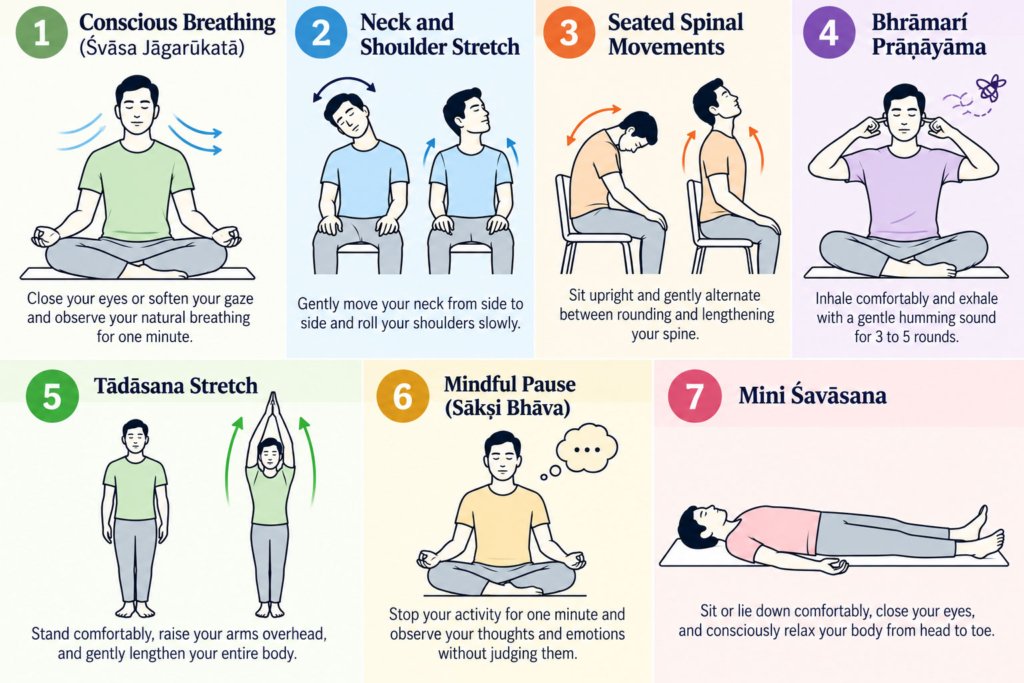
1. Conscious Breathing (Śvāsa Jāgarūkatā)
Duration: 1 minute
Sit comfortably with your spine naturally upright. Close your eyes, if appropriate, or soften your gaze.
Bring your attention to the natural movement of your breath. Observe each inhalation and exhalation without deliberately changing its rhythm.
Notice the gentle movement of your abdomen or chest.
How it helps: Conscious breathing encourages present-moment awareness and may help settle mental restlessness. It also allows you to recognise changes in your breathing during stressful situations.
Practical application: Try this before beginning your workday, joining an important meeting, or moving from one demanding task to another.
Remember, the objective is not to control the breath but to become aware of it.
2. Neck and Shoulder Relaxation
Duration: 1-2 minutes
Sit comfortably with your shoulders relaxed.
Slowly tilt your head towards one shoulder, return to the centre, and repeat on the opposite side. Follow this with gentle shoulder rolls in both directions.
Keep the movements smooth and within a comfortable range.
How it helps: Gentle neck and shoulder movements may reduce the sensation of muscular stiffness associated with prolonged sitting, screen use, and sustained postures.
Practical application: Perform this after a long video call, during a short work break, or whenever you notice unnecessary tension around your shoulders.
Avoid forceful stretching, rapid neck rotations, or movements that produce pain or dizziness.
3. Seated Spinal Movements
Duration: 1-2 minutes
Sit towards the front of a stable chair with your feet resting comfortably on the floor.
As you inhale, gently lengthen your spine and allow your chest to open.
As you exhale, slowly round your upper back within a comfortable range.
Repeat these movements five to eight times, coordinating them with natural breathing.
How it helps: Gentle spinal movements encourage mobility, improve awareness of posture, and may reduce stiffness caused by prolonged sitting.
Practical application: This is particularly useful for people who spend several hours working at computers.
Move gradually, especially if you have existing spinal discomfort. Avoid forcing the movement or pushing into pain.
4. Bhrāmarī Prāṇāyāma
Duration: Approximately 1 minute
Sit comfortably with your spine upright and shoulders relaxed.
Inhale gently through your nose.
While exhaling, produce a soft, steady humming sound, similar to the sound of a bee.
Allow the exhalation to remain smooth and comfortable.
Practise three to five rounds.
You may keep your hands resting on your knees. Closing the ears is optional and not essential for this brief practice.
How it helps: The gentle humming and prolonged, comfortable exhalation may encourage relaxation and help settle mental restlessness.
Practical application: Try Bhrāmarī after a mentally demanding activity or before beginning your evening relaxation routine.
Avoid straining your breath or forcing a prolonged exhalation.
5. Tādāsana Stretch
Duration: 1 minute
Stand comfortably with your feet firmly supported on the floor.
As you inhale, slowly raise your arms overhead and gently lengthen your body upwards.
Maintain natural breathing without creating unnecessary tension.
As you exhale, lower your arms and relax.
Repeat three to five times.
How it helps: This simple movement encourages postural awareness, gentle muscular engagement, and a sense of lengthening after prolonged sitting.
Practical application: Practise it after getting up from your desk, between household activities, or during a short break from sitting.
The purpose is to create comfortable extension, not to stretch as far as possible.
6. Mindful Pause (Sākṣī Bhāva)
Duration: 1 minute
Stop whatever you are doing for a moment.
Sit or stand comfortably and bring your attention inward.
Observe your thoughts, emotions, and bodily sensations without immediately judging, suppressing, or reacting to them.
Simply recognise what is happening within you.
How it helps: Sākṣī Bhāva, or the attitude of witnessing, encourages self-awareness and helps create a conscious space between an emotional impulse and our response.
Practical application: Practise this before responding to a difficult message, entering a stressful conversation, or making an emotionally charged decision.
The intention is not to eliminate thoughts or emotions, but to observe them with greater clarity.
7. Mini Śavāsana
Duration: 1-2 minutes
Sit comfortably in a supported chair or lie down on your back.
Close your eyes if it feels safe and comfortable.
Consciously relax your forehead, jaw, shoulders, arms, abdomen, legs, and feet.
Allow your breathing to remain natural.
For a few moments, experience the sensation of consciously resting without trying to achieve anything.
How it helps: Brief conscious relaxation may reduce the sensation of accumulated muscular tension and provide a refreshing pause during a demanding day.
Practical application: Practise Mini Śavāsana after completing an important task, during an afternoon break, or before going to bed.
Even a short period of conscious relaxation can become a meaningful opportunity to reconnect with yourself.
How to Include These Practices in Your Daily Routine
You do not have to perform all seven practices together.
Instead, identify small opportunities already available in your day.
For example, begin your morning with one minute of conscious breathing. During work, use gentle neck movements or seated spinal movements to interrupt prolonged sitting. Before an important conversation, practise Sākṣī Bhāva. At the end of the day, use Bhrāmarī or Mini Śavāsana to support relaxation.
This approach makes yoga less dependent on finding additional time and more connected to the way we live.
Three Principles for Making Short Practices Effective
1. Prioritise awareness over repetition.
Performing a movement mechanically is different from practising it with attention. Notice your posture, breathing, and physical sensations.
2. Practise regularly rather than occasionally.
A small practice repeated consistently can help establish a sustainable habit. Choose moments that naturally fit your daily schedule.
3. Respect your body’s limitations.
Yoga should not become another source of pressure. Practise within your comfortable capacity and modify or avoid movements that cause discomfort.
Common Mistakes to Avoid
Trying to achieve too much in too little time: A one-minute practice is not a challenge to perform as many movements as possible. Keep the pace comfortable.
Holding or forcing the breath: Unless specifically instructed in an appropriate practice, allow breathing to remain natural and unstrained.
Practising without attention: The value of these techniques lies partly in the awareness developed during their performance.
Expecting immediate transformation: Brief practices may offer useful moments of movement and relaxation, but they are not instant solutions to chronic stress, pain, or other health concerns.
Abandoning longer sessions completely: Whenever possible, continue a balanced yoga routine that includes suitable movement, breathing, relaxation, and meditation.
Bringing Yoga Beyond the Mat
The real challenge for many people is not understanding the benefits of yoga. It is integrating yoga into an already demanding lifestyle.
This is where the practical wisdom of yoga becomes especially relevant.
Patañjali describes two important foundations of yogic discipline: Abhyāsa, sustained practice, and Vairāgya, non-attachment.
In Yoga Sūtra 1.12, these principles are presented as means of bringing steadiness to the mind.
In everyday life, Abhyāsa reminds us to return to practice consistently, while Vairāgya encourages us not to become unnecessarily attached to rigid expectations about how our practice must look.
If you cannot practise for an hour today, it does not mean you must abandon yoga altogether.
Perhaps today your practice is simply one minute of breathing, a gentle stretch, or a conscious pause before reacting.
What matters is that you continue cultivating awareness.
Your Daily Mini Yoga Checklist
– Have I observed my breathing consciously today?
– Have I moved my body after prolonged sitting?
– Have I noticed unnecessary physical tension?
– Have I paused before reacting to a stressful situation?
– Have I allowed myself a moment of conscious relaxation?
You need not complete every item every day. Use these questions as gentle reminders rather than another set of obligations.
Frequently Asked Questions
1. Can one minute of yoga really be useful?
Yes. A brief practice can provide an opportunity for movement, relaxation, or mindful awareness, although its effects depend on the technique, individual, and consistency.
2. Can I practise yoga without a mat?
Yes. Breathing awareness, seated movements, mindfulness, and several gentle stretches can be performed without a yoga mat.
3. Which yoga practice is best during office hours?
Conscious breathing, neck and shoulder relaxation, and seated spinal movements are convenient options for many office workers.
4. Can beginners perform these seven practices?
Most are beginner-friendly when performed gently. Individuals with relevant health concerns may require modifications or professional guidance.
5. Is Bhrāmarī suitable for a short work break?
Yes. Three to five comfortable rounds can fit into a brief break, provided the practice does not cause discomfort.
6. Can short yoga practices reduce stress?
They may help some people feel calmer and more aware of stress-related tension. They should not be considered substitutes for appropriate treatment when stress is persistent or severe.
7. How often should I practise mini yoga sessions?
You can incorporate brief practices at convenient intervals throughout the day, according to your needs and comfort.
8. Can I practise immediately after eating?
Gentle breathing awareness and mindful pauses are generally convenient after meals. Avoid uncomfortable movements or demanding practices immediately after eating.
9. Is Mini Śavāsana the same as sleeping?
No. Mini Śavāsana involves conscious relaxation while maintaining gentle awareness, although drowsiness may sometimes occur.
10. Can these practices replace a complete yoga session?
Not entirely. They complement structured yoga practice but may not provide the same range of physical and psychological experiences as a comprehensive session.
11. Which practice can help when I feel emotionally overwhelmed?
A mindful pause or gentle breathing awareness may help you notice your emotional state and respond more deliberately. Seek additional support if distress is intense or persistent.
12. What is the most important principle in practising yoga with limited time?
Consistency combined with awareness. Choose a manageable technique and practise it without turning yoga into another demanding task.
Conclusion: Make Yoga Part of Life, Not Another Task
We often wait for the perfect time to practise yoga.
A quieter morning. A lighter work schedule. Fewer responsibilities. An uninterrupted hour.
But life rarely offers perfect conditions.
The beauty of yoga lies in its adaptability. Its principles can accompany us while sitting at a desk, walking between meetings, managing family responsibilities, or preparing to rest.
Yoga does not always demand that we withdraw from our daily activities. It can teach us to participate in those activities with greater awareness, steadiness, and balance.
Yoga is not always about finding an extra hour in your day. It is about bringing awareness, movement, and relaxation into the moments you already have.
Even two mindful minutes can be a meaningful beginning.
Start with one practice today. Allow it to become familiar. Gradually discover how yoga can move beyond the mat and become part of your everyday life.
For practical guidance on integrating traditional yogic principles into modern lifestyles, explore more articles and resources at “Athatoyoga“.
— Omkar Gotkhindikar
Athatoyoga