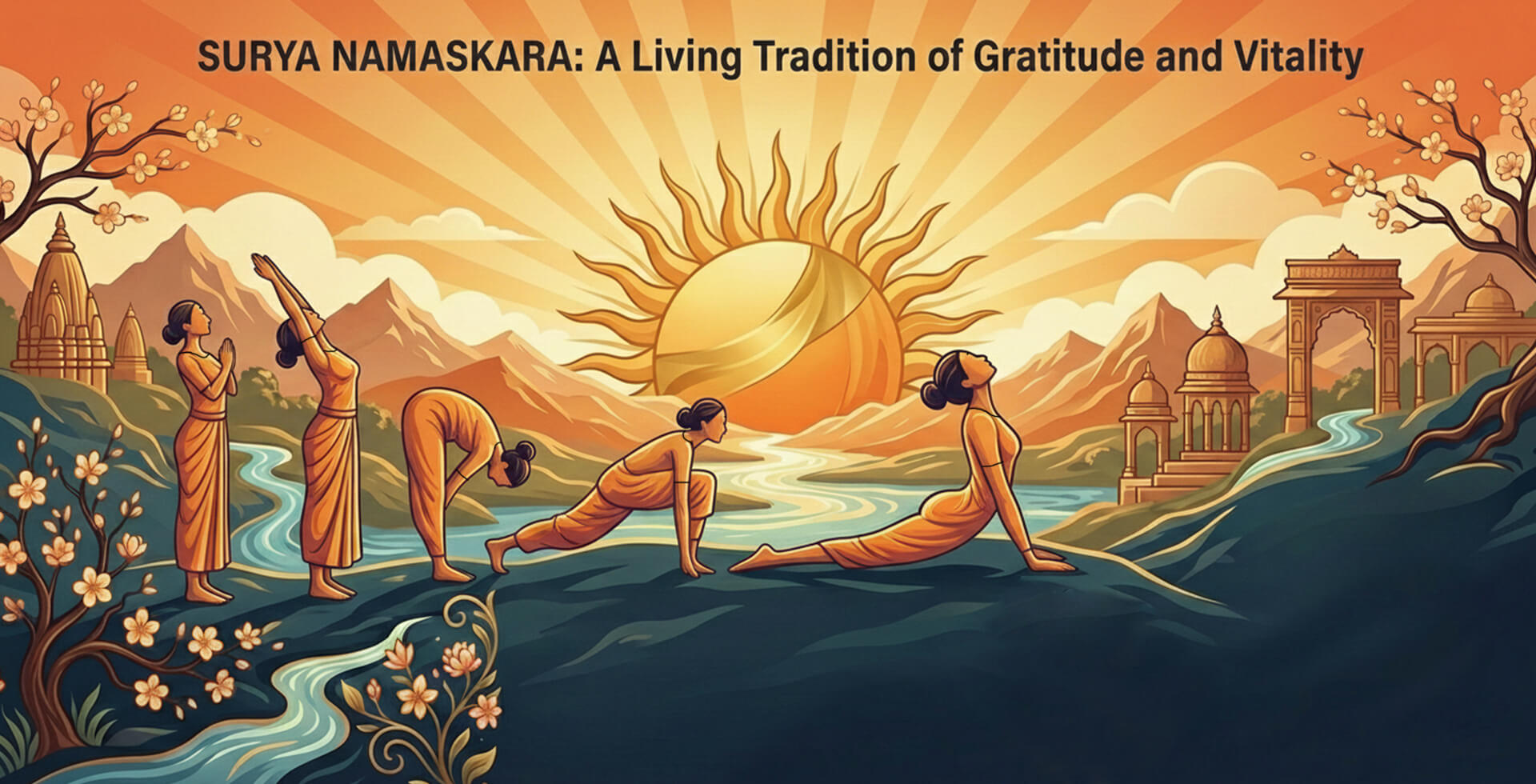
Surya Namaskara: A Living Tradition of Gratitude and Vitality
Surya Namaskara is a traditional yogic practice in which physical movement is rhythmically coordinated with breath. While different yoga schools may vary in the technical execution of individual postures, the fundamental structure and intent of Surya Namaskara remain the same across traditions.
Ideally, Surya Namaskaras are practiced early in the morning at sunrise, a time considered most conducive for absorbing solar energy. Some traditions also recommend practice during sunset. Beyond its physical aspect, Surya Namaskara is performed as an offering of gratitude to the Sun—the primary source of life energy on our planet.
The Vedas repeatedly glorify Surya as Pratyakṣa Devatā—the visible form of the Divine. The Ṛig Veda proclaims:
“उद् उ त्यं जातवेदसं देवं वहन्ति केतवः”
(Ṛig Veda 1.50)
Meaning:
The radiant rays carry the all-knowing Sun, the divine source of life.
Similarly, the Āditya Hṛdayam from the Rāmāyaṇa (Yuddha Kāṇḍa)—a powerful hymn taught to Śrī Rāma by Sage Agastya—declares:
“आदित्यहृदयं पुण्यं सर्वशत्रुविनाशनम्”
Meaning:
The sacred hymn of the Sun that removes all obstacles and grants strength.
This hymn reflects the qualities of physical vitality, inner courage, and victorious resolve that are cultivated through the regular practice of Surya Namaskara.
Although Surya Namaskara as a specific sequence is not explicitly named in ancient yogic texts, Haṭha Yoga literature provides its philosophical foundation. The word Haṭha itself is symbolic—Ha representing the Sun and Ṭha the Moon. Surya Namaskara primarily awakens Piṅgalā Nāḍī, the solar energy channel, making it a practical expression of Haṭha Yoga philosophy.
The Īśopaniṣad offers a profound mantra often recited as an opening prayer before Surya Namaskara practice, followed by the traditional Surya Namaskara mantras for each step:
हिरण्मयेन पात्रेण सत्यस्यापिहितं मुखम्।
तत् त्वं पूषन्नपावृणु सत्यधर्माय दृष्टये ॥
Transliteration:
hiraṇmayena pātreṇa satyasyāpihitaṁ mukham |
tat tvaṁ pūṣann apāvṛṇu satyadharmāya dṛṣṭaye ||
Meaning:
The face of Truth is covered by a radiant golden veil. O Sun, the Nourisher, remove that veil so that the Truth may be revealed.
Thus, while Surya Namaskara is not documented as a single fixed sequence in ancient scriptures, its essence is deeply rooted in Vedic Surya Upāsanā, Purāṇic namaskāra traditions, and Haṭha Yoga principles.
Traditionally, twelve rounds of Surya Namaskara are practiced daily, symbolizing the twelve solar phases. Advanced practitioners may perform up to 108 rounds or more as part of sādhana and tapas.
Here are some benefits of regular practice of Surya Namaskara:
- Enhances flexibility of the spine and joints, keeping the body supple and active.
- Improves digestion and metabolism by massaging abdominal organs.
- Regulates body weight by stimulating metabolic fire (Agni) and burns excess fat from the body .
- Strengthens muscles of the arms, shoulders, back, core, and legs in a balanced way which gives a proper shape to the body.
- Regular practice helps in balanced harmonal function in the body .
- Improves cardiovascular health when practiced rhythmically with breath.
- Enhances lung capacity and oxygenation through coordinated breathing , very effective for respiratory disorders .
- Calms the mind and reduces stress, helping regulate the nervous system.
- Improves emotional balance, beneficial for mood and vitality.
- Activates pranic flow, especially through Manipura and Anahata chakras, increasing energy and positivity.