Are We Rethinking Happiness?
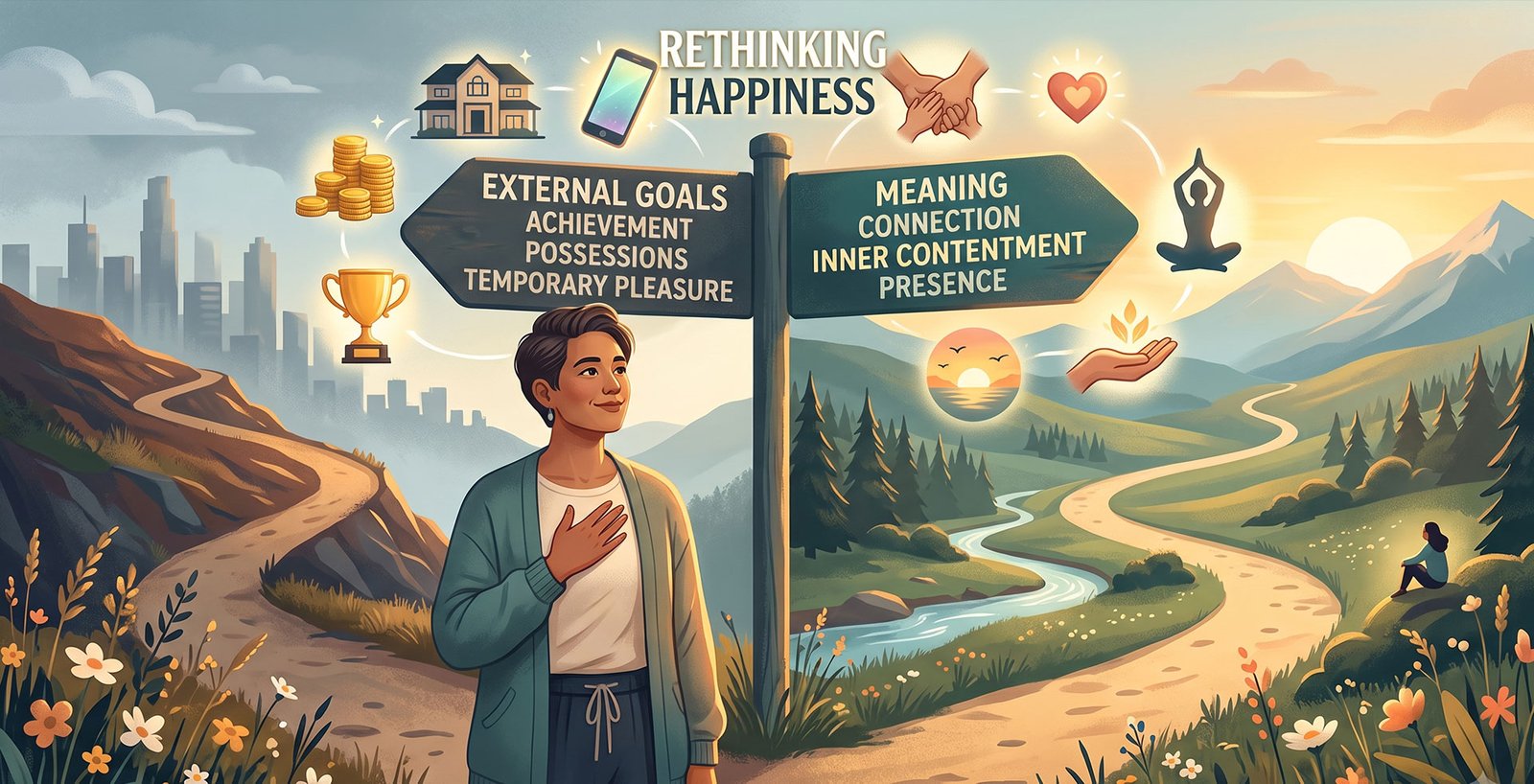
What does happiness really mean to us today? Rethinking happiness may mean looking beyond achievement, possessions and temporary pleasure and asking a deeper question: What genuinely gives my life meaning, connection and inner contentment? For many people, the experience of the pandemic shifted this understanding- from constantly pursuing the next thing to appreciating relationships, security, health, presence and simply being alive.
Last week, I asked a simple question on my Instagram status:
“What is the meaning of happiness for you? Has its meaning changed after the pandemic?”
The responses were surprisingly diverse.
And perhaps more importantly, they made me pause and rethink my own understanding of happiness.
Happiness Does Not Mean the Same Thing to Everyone
For many people, happiness meant being with loved ones and family.
For some, it meant emotional, financial or personal security.
For others, happiness was connected to fulfilling dreams, achieving goals and experiencing the satisfaction that comes from moving forward in life.
And then there were responses that were much simpler:
Being alive.
Being able to breathe.
Being present in this moment.
There was something profound about that last perspective.
Because perhaps happiness is not always about adding something to our lives.
Sometimes, it is about becoming aware of what is already here.
The Pandemic Changed More Than Our Routine
The pandemic disrupted our routines, plans and assumptions about the future.
It also forced many of us to confront questions that we could previously postpone.
What really matters?
What can I live without?
Who do I want around me?
What does security mean to me?
Am I actually enjoying the life I am working so hard to create?
These questions do not necessarily have one correct answer.
But asking them can change the way we live.
For some, the experience created a deeper appreciation for family and relationships. For others, it highlighted the importance of financial stability, health or emotional security. Some became more conscious of time and started pursuing long-delayed dreams.
In other words, our circumstances may change, but so does our perception of what makes life meaningful.
That is why rethinking happiness is not about finding a universal definition.
It is about discovering what happiness means to you now.
—
Why Rethinking Happiness Matters
One of the interesting things about happiness is that we often pursue it indirectly.
We tell ourselves:
“Once I achieve this, I will be happy.”
“Once I earn enough, I will feel secure.”
“Once I reach that position, I will finally relax.”
“Once I lose weight, buy a house, travel more or accomplish this goal, I will feel fulfilled.”
Goals are not the problem.
The problem begins when we make happiness permanently dependent on the next achievement.
Because the moment one goal is achieved, the mind often creates another.
This can turn life into an endless cycle:
Want → achieve → temporary satisfaction → new want → repeat.
There is nothing wrong with ambition. Growth is important.
But it is worth asking:
Am I pursuing this because it genuinely matters to me?
use I believe it will finally make me happy?
That one question can reveal a lot.
—
Happiness: Pleasure, Achievement or Contentment?
It may help to distinguish between different experiences that we often call happiness.
Experience→What it may feel like→What it depends on
Pleasure→Excitement, enjoyment→External experience
Achievement→Satisfaction, pride→Reaching a goal
Security→Relief, stability→Emotional or material conditions
Connection→Love, belonging→Relationships
Contentment→Inner ease, acceptance→Relationship with oneself
Meaning→Fulfilment, purpose→Living according to values
These experiences can overlap.
There is nothing wrong with pleasure, achievement or material security. They are meaningful parts of human life.
But they are not necessarily the whole picture.
A person can achieve many things and still feel empty.
Another person may have a relatively simple life and experience a deep sense of contentment.
This is where awareness becomes important.
—
The Question Behind the Question
Instead of only asking:
“Am I happy?”
perhaps we can ask:
“What is creating my happiness- and what is disturbing it?”
Try looking at different areas of your life:
– Relationships
– Work
– Finances
– Physical health
– Sleep and rest
– Digital consumption
– Personal goals
– Emotional wellbeing
– Spiritual practice
– Time spent with yourself
Then ask:
Which areas are giving me energy?
Which areas are constantly draining me?
Where am I living according to my values?
Where am I simply responding to expectations?
These questions can transform happiness from an abstract idea into something we can observe in everyday life.
—
A Simple Framework for Rethinking Happiness
You don’t necessarily need to make dramatic changes.
Start with four simple steps.
1. Observe
Notice what currently makes you happy.
Don’t judge it.
Just observe.
Is it an achievement? Family? Travel? Recognition? Money? Creativity? Nature? Silence? Service? Spiritual practice?
Awareness comes before change.
2. Question
Ask yourself:
“Is this happiness coming from within me, or is it completely dependent on something outside me?”
External circumstances will always influence us.
The goal is not to become unaffected by life.
The goal is to develop enough inner stability that every change does not completely determine our state of mind.
3. Reorganise
If your happiness depends almost entirely on achievement, recognition or external circumstances, consider creating more space for things that nourish you internally.
Perhaps that means:
– Spending meaningful time with family
– Walking without your phone
– Practising yoga
– Sitting quietly for a few minutes
– Connecting with nature
– Pursuing a creative interest
– Serving someone without expecting anything in return
– Sleeping better
– Reducing unnecessary digital stimulation
Small changes can gradually change the quality of everyday life.
4. Practise
Understanding happiness intellectually is not enough.
It has to become a way of living.
This is where practices such as yoga, meditation, pranayama and self-observation can become useful- not as magical solutions, but as tools for developing awareness.
The more clearly we observe ourselves, the better we can understand what actually creates balance in our lives.
—
Happiness and Spiritual Evolution
Spiritual evolution is sometimes presented as something mysterious, extraordinary or distant from ordinary life.
I see it differently.
It can begin with something very simple:
Becoming more conscious of how we live.
How do I respond when things don’t go my way?
Why do I constantly need external validation?
Why am I unable to sit quietly?
Why am I always looking for the next achievement?
Why do I compare my life with someone else’s?
Why does one small event completely change my state of mind?
These are not merely philosophical questions.
They are opportunities for self-observation.
And self-observation can gradually become sadhana.
Spiritual growth does not necessarily require escaping everyday life.
It can happen while we are working, raising a family, building a career, facing difficulties, caring for others and pursuing our dreams.
The difference is the quality of awareness with which we do these things.
—
Are We Doing What We Love- or What We Think We Should Do?
This may be one of the most important questions in our search for happiness.
Sometimes we are not unhappy because life is objectively bad.
We are unhappy because the life we are living does not feel aligned with who we are becoming.
We may be pursuing a goal because society considers it successful.
We may be maintaining relationships purely because of expectations.
We may be working endlessly because we have forgotten what “enough” means.
We may even be practising spirituality because we think we should, rather than because it genuinely brings awareness and depth to our lives.
So pause.
Ask yourself:
“Is what I am doing coming from joy, meaning and awareness- or am I doing it mainly because I am afraid, conditioned or seeking approval?”
There may not be an immediate answer.
That’s okay.
The question itself is valuable.
—
Common Mistakes We Make About Happiness
Waiting for the perfect life
Life will probably never become perfectly arranged.
If happiness requires perfect circumstances, it will always remain postponed.
Confusing excitement with happiness
Excitement is intense but temporary.
Contentment can be much quieter.
Making achievement the only measure of success
Goals are important, but achievement alone cannot define the quality of your life.
Comparing your happiness with someone else’s
Social media can make other people’s lives appear complete.
We rarely see the full story behind the image.
Thinking spirituality means giving up ambition
Spiritual awareness does not require abandoning goals.
It asks us to understand our relationship with those goals.
—
A Practical Happiness Check-In
Take five minutes once a week and answer these questions honestly:
– What made me genuinely happy this week?
– What drained me?
– Where did I feel most peaceful?
– Who did I enjoy being with?
– What did I do only to receive approval?
– What am I chasing right now?
– If I achieved it, would it genuinely improve my life?
– What am I taking for granted?
– What can I simplify?
– What deserves more of my attention?
Don’t try to produce perfect answers.
Simply observe.
Sometimes awareness itself begins the transformation.
—
My Takeaway From the Responses
The responses to my Instagram question reminded me of something important:
Happiness is not a fixed concept.
It evolves as we evolve.
What made us happy at twenty may not satisfy us at forty.
What we considered success yesterday may not feel meaningful tomorrow.
Our priorities change.
Our experiences change.
Our understanding of ourselves changes.
And perhaps that is not a problem.
Perhaps that is life.
The real question is whether we are conscious enough to notice that change and wise enough to adjust the way we live.
If your happiness meter is not where you want it to be, perhaps it is time to rethink- not only your goals, but also your perception, your methods and the tools you use to live your life.
—
Frequently Asked Questions
1. What does rethinking happiness mean?
Rethinking happiness means examining our assumptions about what makes us happy and considering whether our current goals, relationships, lifestyle and values genuinely contribute to wellbeing.
2. Has the meaning of happiness changed after the pandemic?
For many people, the pandemic increased appreciation for relationships, health, security, presence and time. However, the experience differs from person to person.
3. Is happiness the same as pleasure?
No. Pleasure is often temporary and connected to enjoyable experiences. Happiness can also involve contentment, meaning, connection and inner stability.
4. Can achieving goals make us happy?
Achievement can create genuine satisfaction. However, if happiness is always postponed until the next achievement, satisfaction may remain temporary.
5. Can yoga help with happiness?
Yoga can support self-awareness, emotional regulation and a more balanced relationship with one’s thoughts and experiences. Its value comes through regular practice rather than instant results.
6. What is the relationship between happiness and spirituality?
Spirituality can encourage deeper self-observation and help us examine our desires, attachments, reactions and values. This may gradually change our understanding of happiness.
7. Why do successful people sometimes feel unhappy?
External success does not automatically provide emotional connection, meaning, inner stability or contentment.
8. How can I become happier in everyday life?
Begin by observing what genuinely nourishes you, strengthening meaningful relationships, reducing unnecessary distractions and making time for practices that create awareness and balance.
9. Does being content mean giving up ambition?
No. Contentment and ambition can coexist. The important question is whether ambition is driven by meaningful growth or by endless dissatisfaction.
10. Can happiness be practised?
While happiness is not something we can force, we can cultivate habits that support wellbeing, awareness, connection, gratitude, meaningful action and inner balance.
11. Is happiness a destination?
It may be more useful to see happiness as an ongoing quality of living rather than a final destination that we reach once and permanently possess.
—
Maybe Happiness Is the Way We Travel
Perhaps happiness is not a destination after all.
Perhaps it is the way we learn to keep moving.
To grow.
To adapt.
To become more aware.
To appreciate what is already present without abandoning our desire to grow.
Life will continue to bring uncertainty, success, failure, loss, relationships, responsibilities and unexpected turns.
We cannot control everything that happens.
But we can gradually become more conscious of how we meet life.
And maybe that is where a deeper form of happiness begins.
Not having everything we want.
Not in eliminating every difficulty.
But in developing the awareness to live fully with what life brings.
So, perhaps today, ask yourself one simple question:
“What does happiness mean to me now?”
Not five years ago.
Not according to society.
Not according to social media.
To me. Now.
And then, perhaps, take one small step towards living that answer.
Keep swimming, as Dory says. 🐠
A Small Invitation
If this reflection made you pause, don’t rush to answer it.
Sit with the question.
Observe yourself.
And perhaps let your understanding of happiness evolve along with you.
Because sometimes, the journey towards happiness begins when we stop chasing it- and start becoming more aware of how we are living.