Emotions, Consciousness, and the Path of Bhakti
Human beings undergo countless worldly experiences and express them through a wide spectrum of emotions. Emotions, in essence, are thoughts that recur with intensity. Just as our experiences are varied, so too is the range and depth of our emotional responses. If we observe closely, we may notice that the intensity of emotions does not remain the same for repeated experiences over time. Certain experiences may continue to bring joy, while others may cause deep pain, and at times, these responses can even interchange. What once delighted us may later lose its charm, and what once hurt us may no longer disturb us. When viewed from a broader perspective, a question naturally arises: Are we blessed with emotions merely for survival or sensory engagement? A famous quote says, “Humans are basically mobile cucumbers with emotions.”
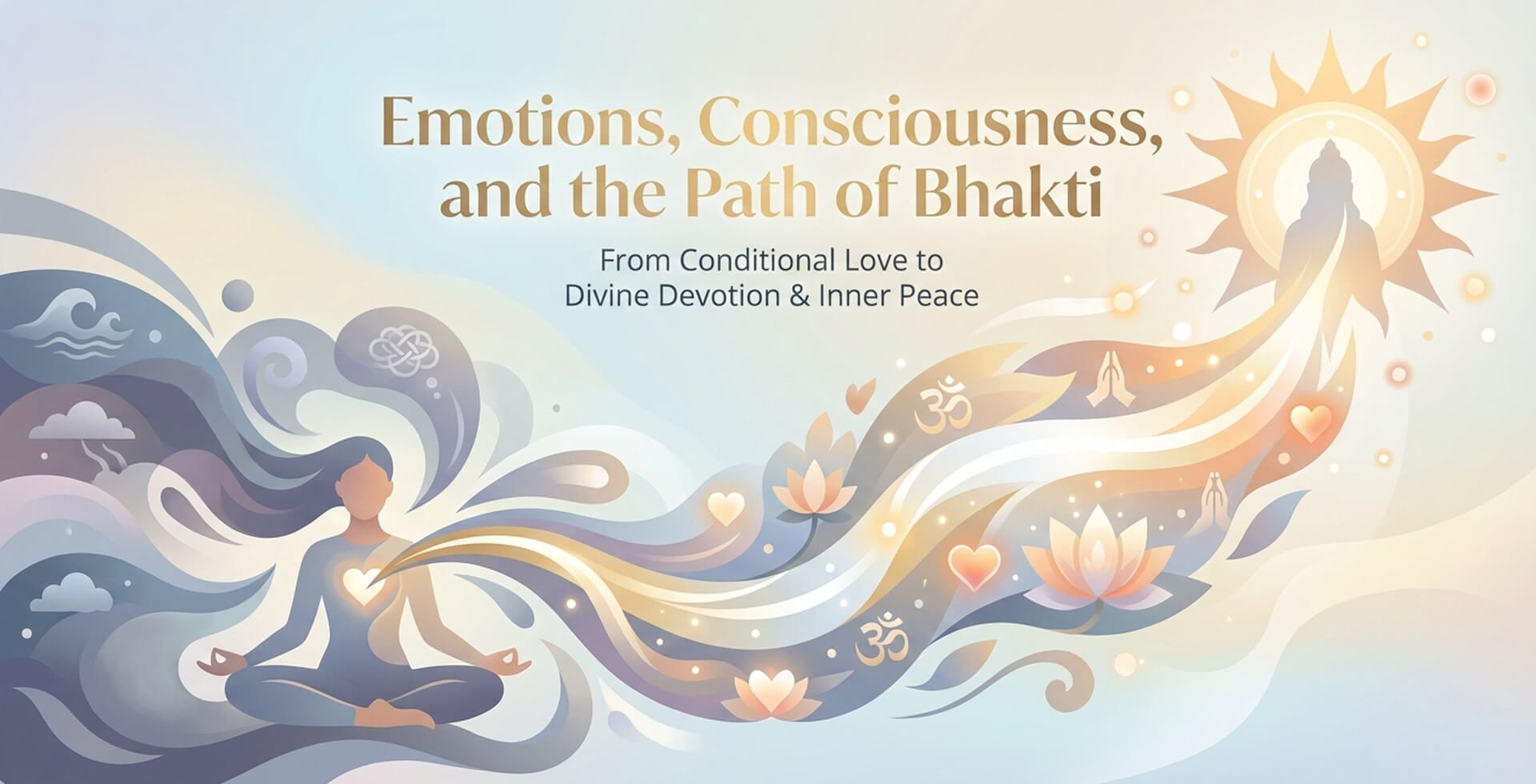
Is this truly the extent of our existence? Upon deeper introspection, we arrive at a more profound understanding. Emotions exist to guide us toward a higher dimension of being-Bhakti, or devotion. Among all emotions, love stands as the highest and most transformative. It is often an unconventional experience, yet we habitually limit this beautiful feeling by attaching conditions to it. Once conditions arise, there is always the fear of their fulfillment or failure, which leads to discomfort and suffering. However, when we let go of expectations and experience Prema-love without Kaama (desire), it naturally transforms into Bhakti, pure devotion.
This letting go of expectations is far from simple in practice, though it may sound effortless in theory. It requires us to consciously approach every situation in life as an opportunity to elevate our awareness rather than becoming entangled in emotional turmoil. Despite repeated efforts, the outcomes may vary. Yet, by holding the intention and understanding that we are merely instruments in the divine master plan, the कर्ता भाव (doer-ship) gradually dissolves and is replaced by निमित्तभाव-the attitude of being an instrument.
As this shift deepens, our relationship with the deity we are connected to becomes finely attuned. Eventually, even the mere remembrance of the deity’s name or image can transport us into an ecstatic experience of divine presence. We continue to perform our duties, yet surrender all outcomes to the divine will.
In today’s world, with its overwhelming physical, mental, emotional, and social demands, Bhakti emerges as the simplest and most graceful path to living with happiness and inner peace.