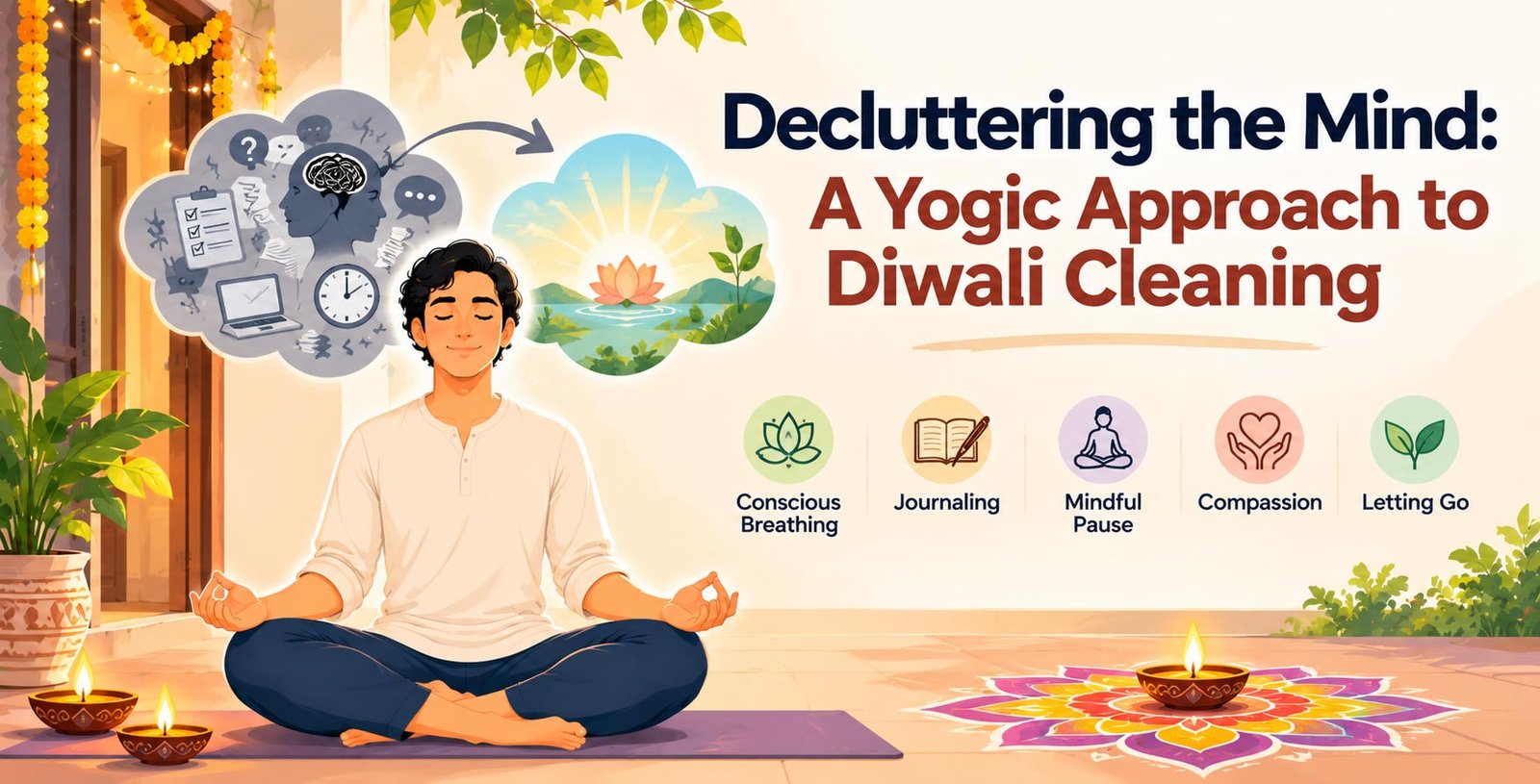
Decluttering the Mind: A Yogic Approach to Diwali Cleaning
Five simple yogic practices to cultivate inner cleanliness, emotional balance, and mental clarity.
Every year, as Diwali approaches, households across India begin a familiar ritual. Cupboards are reorganised, unnecessary belongings are discarded, walls receive fresh coats of paint, and every corner of the house is cleaned.
Traditionally, this preparation is associated with welcoming Goddess Lakshmi, the embodiment of wealth, abundance, and prosperity, into a clean and welcoming environment.
But while we carefully remove dust and clutter from our homes, an important question often goes unanswered:
When was the last time we cleaned the space within ourselves?
Our minds, too, accumulate clutter in the form of repetitive thoughts, unresolved emotions, unnecessary expectations, and constant mental activity.
Yoga offers a beautiful approach to this internal cleansing through the principle of Śaucha (purity or cleanliness).
What Is Mental Decluttering in Yoga?
Mental decluttering is the conscious practice of recognising and reducing unnecessary mental and emotional burdens. In yoga, Śaucha encourages purity and cleanliness in both external and internal life. Through breath awareness, self-reflection, compassion, silence, and non-attachment, we can cultivate greater mental clarity and a more balanced relationship with our thoughts and emotions.
Diwali Cleaning and the Japanese Tradition of Ōsōji
Interestingly, the idea of cleaning as a preparation for renewal is not limited to Indian culture.
In Japan, there is a traditional practice called Ōsōji (大掃除), meaning great cleaning.
Usually performed towards the end of the year, Ōsōji involves thoroughly cleaning homes, workplaces, and other spaces in preparation for the New Year.
Beyond ordinary housekeeping, it represents an opportunity to leave behind the accumulated dust and disorder of the previous year and welcome a fresh beginning.
There is a meaningful similarity between this Japanese tradition and the Indian custom of cleaning homes before Diwali.
Both recognise the importance of preparing our surroundings for renewal.
However, these traditions also invite a deeper reflection.
What if we approached our minds with the same attention that we give to cleaning our homes?
Just as unnecessary objects occupy physical space, unresolved emotions, repetitive worries, and rigid expectations can occupy our mental space.
This is where the yogic understanding of cleanliness becomes particularly relevant.
Understanding Śaucha: The Yogic Principle of Purity
In Patañjali’s Aṣṭāṅga Yoga, Śaucha is the first of the five Niyamas, or personal observances.
The five Niyamas are:
1. Śaucha – Cleanliness and purity
2. Santoṣa – Contentment
3. Tapas – Disciplined effort
4. Svādhyāya – Self-study
5. Īśvara Praṇidhāna – Surrender or dedication to a higher principle
Śaucha is not limited to maintaining bodily hygiene or keeping our surroundings clean.
It also invites us to cultivate clarity in our thoughts, intentions, habits, and responses.
Patañjali explains in Yoga Sūtra 2.41:
Sattvaśuddhi-saumanasya-ekāgrya-indriyajaya-ātmadarśana-yogyatvāni ca.
Through purification arise clarity of mind, cheerfulness, one-pointedness, mastery over the senses, and fitness for self-realisation.
This teaching reminds us that cleanliness has a deeper psychological and spiritual dimension.
Importantly, inner purity does not mean suppressing unpleasant emotions or forcing ourselves to think positively.
It means developing the awareness to recognise what is happening within us without being unnecessarily controlled by it.
Let us explore five simple practices inspired by this understanding.
Five Yogic Practices for Decluttering the Mind
1. Conscious Breathing: Clearing Mental Restlessness
Practice: Śvāsa Jāgarūkatā (Breath Awareness)
Have you noticed how quickly the mind moves from one thought to another?
We may be sitting quietly, yet mentally revisiting yesterday’s conversations, planning tomorrow’s activities, or worrying about situations beyond our control.
Conscious breathing provides a simple way to return our attention to the present moment.
How to practise:
1. Sit comfortably with your spine naturally upright.
2. Gently close your eyes or soften your gaze.
3. Observe your natural breathing without trying to control it.
4. Notice the gentle movement of your abdomen during inhalation and exhalation.
5. Whenever thoughts arise, acknowledge them without judgement and return your attention to breathing.
Duration: 3–5 minutes.
Yogic application: Breath awareness encourages steadiness of attention, helps reduce mental restlessness, and creates a conscious pause between thoughts and reactions.
Practical example: Before beginning your Diwali shopping or household preparations, spend three minutes observing your breath. Notice whether this changes the way you approach the next activity.
The purpose is not to stop thinking, but to become less entangled in every thought.
2. Journaling: Identifying Mental Clutter
Practice: Svādhyāya (Self-Reflection)
A cluttered cupboard becomes easier to organise when we first examine what it contains.
The same principle applies to the mind.
Sometimes, we repeatedly think about the same concerns without clearly understanding what is troubling us.
Writing these thoughts down can help us examine them with greater objectivity.
How to practise:
1. Sit quietly with a notebook for five minutes.
2. Write down three thoughts or concerns repeatedly occupying your mind.
3. Identify which concerns are within your control and which are not.
4. Choose one small constructive action you can take today.
5. Conclude by writing one thing for which you are grateful.
Duration: 5 minutes.
Yogic application: Svādhyāya encourages self-observation, recognition of repetitive thought patterns, and greater clarity about personal priorities.
Practical example: If you are worried about completing all your Diwali preparations, write down the pending activities. Identify what is essential, what can be delegated, and what can wait.
Often, clarity begins when our concerns are brought into conscious awareness.
3. Forgiveness: Releasing Emotional Burdens
Practice: Maitrī Bhāvanā (Cultivating Friendliness)
Physical clutter is visible. Emotional clutter is often not.
An unpleasant conversation, a misunderstanding, or an unresolved disagreement may continue occupying our attention long after the incident has passed.
We may repeatedly revisit the situation, imagine different responses, or hold on to resentment.
Forgiveness can be understood as a gradual process of loosening our attachment to these emotional burdens.
How to practise:
1. Sit comfortably and take five slow, natural breaths.
2. Recall a minor disagreement or emotional hurt that you feel ready to explore.
3. Observe the emotions arising without suppressing or judging them.
4. Silently repeat: “May I be peaceful. May I gradually release this resentment.”
5. If comfortable, extend a wish for peace towards the other person.
Duration: 5 minutes.
Yogic application: Maitrī Bhāvanā encourages friendliness, compassion, and emotional balance while helping us reduce repetitive engagement with resentment.
Practical example: During Diwali, you may meet relatives or acquaintances with whom you have experienced disagreements. Rather than rehearsing past conflicts, practise maintaining a calm and respectful attitude while preserving appropriate boundaries.
Forgiveness does not require accepting harmful behaviour, forgetting what happened, or restoring an unhealthy relationship.
Sometimes, emotional cleansing begins simply by deciding not to repeatedly nourish resentment.
4. Mindful Silence: Creating Inner Space
Practice: Mauna (Conscious Silence)
Modern life rarely gives the mind an opportunity to remain undisturbed.
Notifications, conversations, television, social media, and constant information create continuous sensory stimulation.
Even during moments of physical rest, the mind may remain occupied.
Mauna, or conscious silence, offers an opportunity to observe this activity without adding more stimulation.
How to practise:
1. Choose ten minutes during the day to remain silent.
2. Keep your mobile phone, television, and other distractions away.
3. Sit quietly or perform a simple activity with full awareness.
4. Observe sounds, bodily sensations, thoughts, and emotions without immediately reacting.
5. Conclude with three comfortable, natural breaths.
Duration: 10 minutes.
Yogic application: Mauna encourages introspection, reduces unnecessary sensory engagement, and supports the ability to respond thoughtfully rather than impulsively.
Practical example: After completing your morning Diwali preparations, sit quietly for ten minutes without reaching for your phone.
You do not need to create absolute silence around you.
The practice is to reduce unnecessary activity and become more aware of what is already happening.
Silence is not merely the absence of speech. It can become an opportunity for conscious observation.
5. Letting Go of Expectations: Creating Mental Freedom
Practice: Aparigraha Bhāvanā (Reflection on Non-Attachment)
We often carry expectations about how situations, relationships, and people should behave.
We expect appreciation for our efforts, particular responses from others, and specific outcomes from our actions.
When reality does not match these expectations, frustration and disappointment may arise.
Aparigraha, the yogic principle of non-grasping, encourages us to examine unnecessary attachment.
How to practise:
1. Sit comfortably and identify one expectation creating unnecessary stress.
2. Ask yourself: “Am I becoming attached to a particular outcome?”
3. Distinguish between the effort you can make and the result you cannot fully control.
4. Inhale gently and, during a relaxed exhalation, mentally repeat: “I will give my best without clinging to the outcome.”
5. Identify one constructive action you can take without demanding a particular result.
Duration: 5 minutes.
Yogic application: Aparigraha Bhāvanā encourages non-attachment, flexibility, acceptance, and a healthier relationship with expectations.
Practical example: You may put considerable effort into organising a Diwali gathering, yet everything may not happen exactly as planned.
Instead of allowing unmet expectations to overshadow the celebration, focus on your sincere efforts and the opportunity to connect with others.
Non-attachment does not mean giving up responsibilities or ambitions.
It means performing our actions sincerely without allowing every outcome to determine our peace of mind.
How These Five Practices Complement Śaucha
Although Śaucha is the central principle of this discussion, the five practices draw upon several complementary yogic teachings.
Svādhyāya is itself a Niyama, Aparigraha is a Yama, Maitrī is discussed in the Yoga Sūtras as a means of cultivating mental clarity, and Mauna is a broader contemplative discipline.
They are not all formally classified under Śaucha in Patañjali’s system.
However, each can support the broader intention of cultivating inner clarity.
Practice – Area of mental clutter – Yogic approach
Breath awareness – Restlessness – Present-moment awareness
Svādhyāya – Repetitive thoughts – Self-reflection
Maitrī Bhāvanā – Resentment – Compassion
Mauna – Excessive stimulation – Conscious silence
Aparigraha Bhāvanā – Rigid expectations – Non-attachment
Common Mistakes to Avoid During Mental Decluttering
Mental decluttering is not another task to complete perfectly. A few misunderstandings can make the practice unnecessarily difficult.
Trying to eliminate every thought: The objective is not to achieve a completely thoughtless state, but to develop a healthier relationship with mental activity.
Suppressing uncomfortable emotions: Inner cleanliness does not mean denying anger, sadness, fear, or disappointment. Recognising emotions is different from suppressing them.
Forcing forgiveness: Emotional healing is personal and may take time. Begin with experiences that feel manageable.
Confusing non-attachment with indifference: Aparigraha encourages freedom from excessive grasping, not avoidance of responsibility.
Expecting immediate transformation: A few minutes of practice may help create awareness, but deeper changes generally require consistent effort.
A Simple 25-Minute Diwali Mental Cleaning Routine
You can combine all five practices into one short routine or distribute them throughout your day.
Practice – Duration:
Conscious breathing: 3 minutes
Self-reflection and journaling: 5 minutes
Forgiveness reflection: 5 minutes
Mindful silence: 10 minutes
Reflection on expectations: 2 minutes
Total: 25 minutes
Begin with what feels manageable. Even one practice performed consistently can become a meaningful part of your daily routine.
Your Inner Cleaning Checklist This Diwali
Before celebrating, take a moment to reflect:
– Have I spent a few minutes observing my breath?
– Have I identified thoughts unnecessarily occupying my attention?
– Have I reflected on an emotional burden I am ready to release?
– Have I created some time for conscious silence?
– Have I recognised an expectation I can hold more lightly?
The purpose of this checklist is not to judge yourself. It is simply to encourage awareness.
Frequently Asked Questions
1. What does Śaucha mean in yoga?
Śaucha means cleanliness or purity. It is the first Niyama in Patañjali’s Aṣṭāṅga Yoga and encompasses external cleanliness and internal purification.
2. How is mental decluttering connected to Diwali?
Diwali cleaning symbolises renewal and preparation for welcoming prosperity. Mental decluttering extends this intention inward by encouraging clarity, emotional balance, and conscious living.
3. Can yoga help reduce mental clutter?
Yoga offers practices such as breath awareness, meditation, self-reflection, and non-attachment that can help individuals manage repetitive thoughts and respond more consciously to stress.
4. What is the simplest yogic practice for beginners?
Natural breath awareness is an accessible starting point. Sitting comfortably and observing breathing for three to five minutes can help develop attention and awareness.
5. Is mental decluttering the same as stopping thoughts?
No. Mental decluttering involves recognising thoughts and reducing unnecessary engagement with them, rather than attempting to suppress all mental activity.
6. What is the difference between Śaucha and Svādhyāya?
Śaucha concerns cleanliness and purity, while Svādhyāya involves self-study and reflection. Both are Niyamas and can complement each other.
7. How does Mauna help with mental clarity?
Mauna reduces unnecessary verbal and sensory engagement, creating opportunities for introspection and greater awareness of habitual reactions.
8. Does forgiveness mean accepting someone’s harmful behaviour?
No. Forgiveness can involve gradually releasing resentment while maintaining healthy boundaries and personal safety.
9. What is Aparigraha in daily life?
Aparigraha means non-grasping or non-possessiveness. In daily life, it encourages us to reduce excessive attachment to possessions, expectations, and outcomes.
10. How often should we practise mental decluttering?
These practices can be incorporated into daily life. Beginning with five to ten minutes regularly may be more practical than attempting long sessions occasionally.
Conclusion: This Diwali, Clean the Space Within
As we prepare our homes for Diwali, we carefully remove accumulated dust, discard unnecessary belongings, and create space for freshness and light.
Perhaps we can extend the same attention towards our inner world.
Some thoughts need to be examined rather than repeatedly entertained. Some emotions need acknowledgement rather than suppression. Some expectations need to be held more lightly.
Śaucha reminds us that cleanliness is not merely an external activity. It is also an ongoing cultivation of inner clarity.
And just as household cleaning is not limited to one festival, mental decluttering need not be limited to Diwali.
It can become a gentle, conscious practice throughout the year.
This Diwali, along with lighting lamps, decorating our homes, and celebrating prosperity, let us make a little space for awareness, compassion, silence, and acceptance.
“A clean home welcomes light; a clear mind allows us to recognise it.”
Explore more practical applications of yoga, meditation, and yogic philosophy at athatoyoga