Breath, Balance and the Effortless Flow of Life
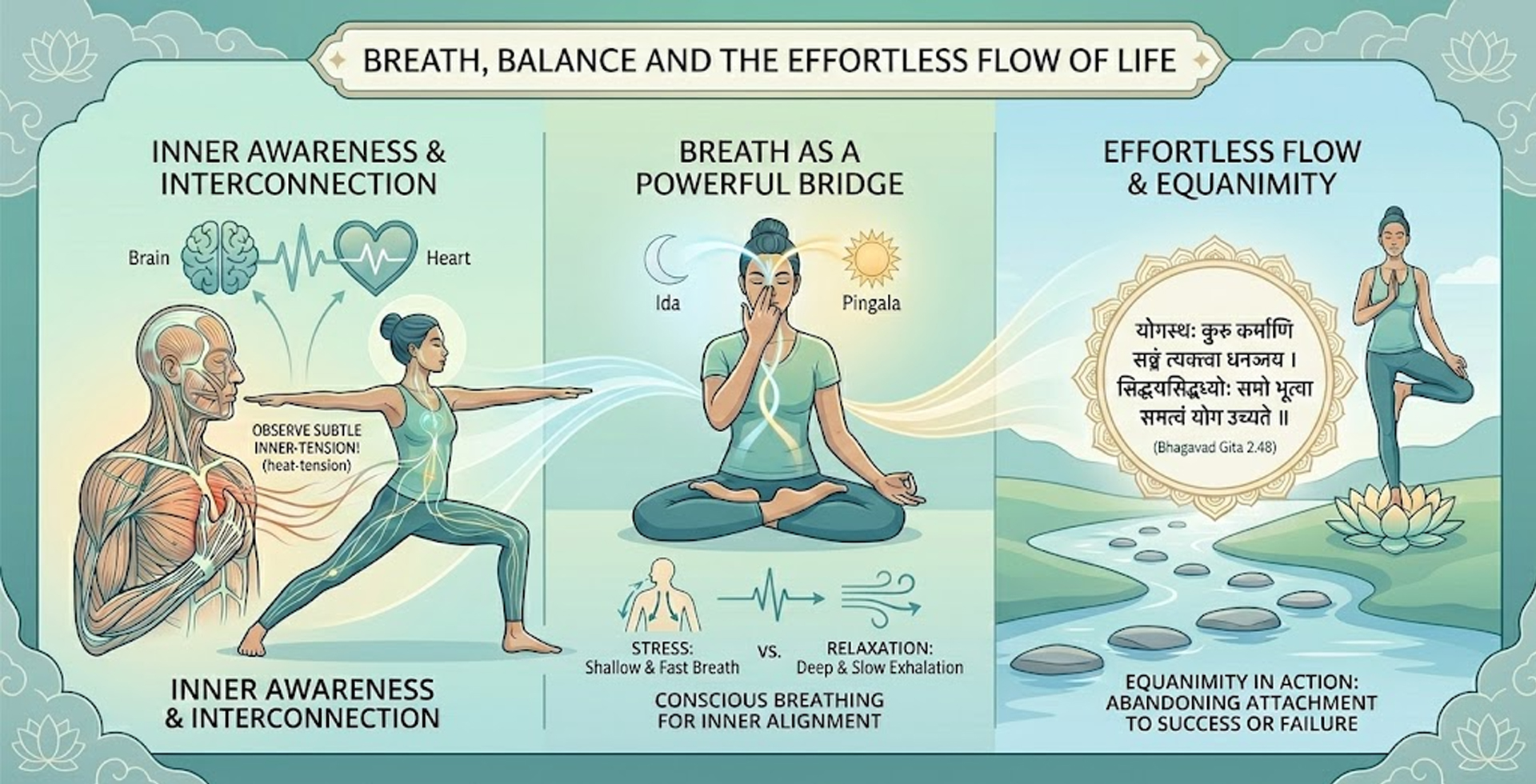
With regular practice and inner awareness, we slowly begin to notice that the body and mind are not separate entities, but deeply interconnected expressions of the same life force. Every emotion leaves an imprint on the body, and every physical imbalance influences the state of the mind. Anxiety may tighten the chest and disturb breathing, while anger may create heat and tension within the nervous system. In the same way, a calm and steady mind reflects through relaxed muscles, balanced breath, and graceful movements. Yogic practices gradually sharpen this observation, allowing us to witness these subtle inner relationships with clarity rather than reacting unconsciously to them.
This is where the breath becomes a powerful bridge. Through conscious breathing practices, one can restore harmony between body and mind. A simple example can be seen during moments of stress-when the mind becomes restless, the breath automatically becomes shallow and fast. But if one consciously slows down the exhalation and deepens the breath, the nervous system begins to relax, and the mind gradually settles. Similarly, practices like Nadi Shodhana Pranayama create balance between the active and passive energies within us, bringing emotional steadiness and mental clarity. Over time, breath ceases to be just a biological process; it becomes a tool for inner alignment and self-regulation.
When this harmony becomes established within, life begins to flow with greater ease and effortlessness. Actions arise with awareness instead of compulsion, and one experiences a deeper sense of balance amidst changing situations. This state is beautifully reflected in the teachings of the Bhagavad Gita:
“योगस्थः कुरु कर्माणि सङ्गं त्यक्त्वा धनञ्जय ।
सिद्ध्यसिद्ध्योः समो भूत्वा समत्वं योग उच्यते ॥”
(Bhagavad Gita 2.48)
Transliteration:
Yogasthaḥ kuru karmāṇi saṅgaṁ tyaktvā dhanañjaya ।
Siddhy-asiddhyoḥ samo bhūtvā samatvaṁ yoga ucyate ॥
Meaning:
“Established in the state of yoga, perform your actions with inner balance, abandoning attachment to success or failure. Such equanimity itself is called Yoga.”
This effortless flow is not laziness or passivity; it is a state where inner resistance dissolves, and one moves in tune with life itself.