Beyond the Body: The Five Dimensions of Human Existence
Indian philosophy offers a profound and layered understanding of human existence. Our sages recognized that what we perceive through our naked eyes or experience via the senses is only the gross aspect of who we are. The human being is far more than the physical form.
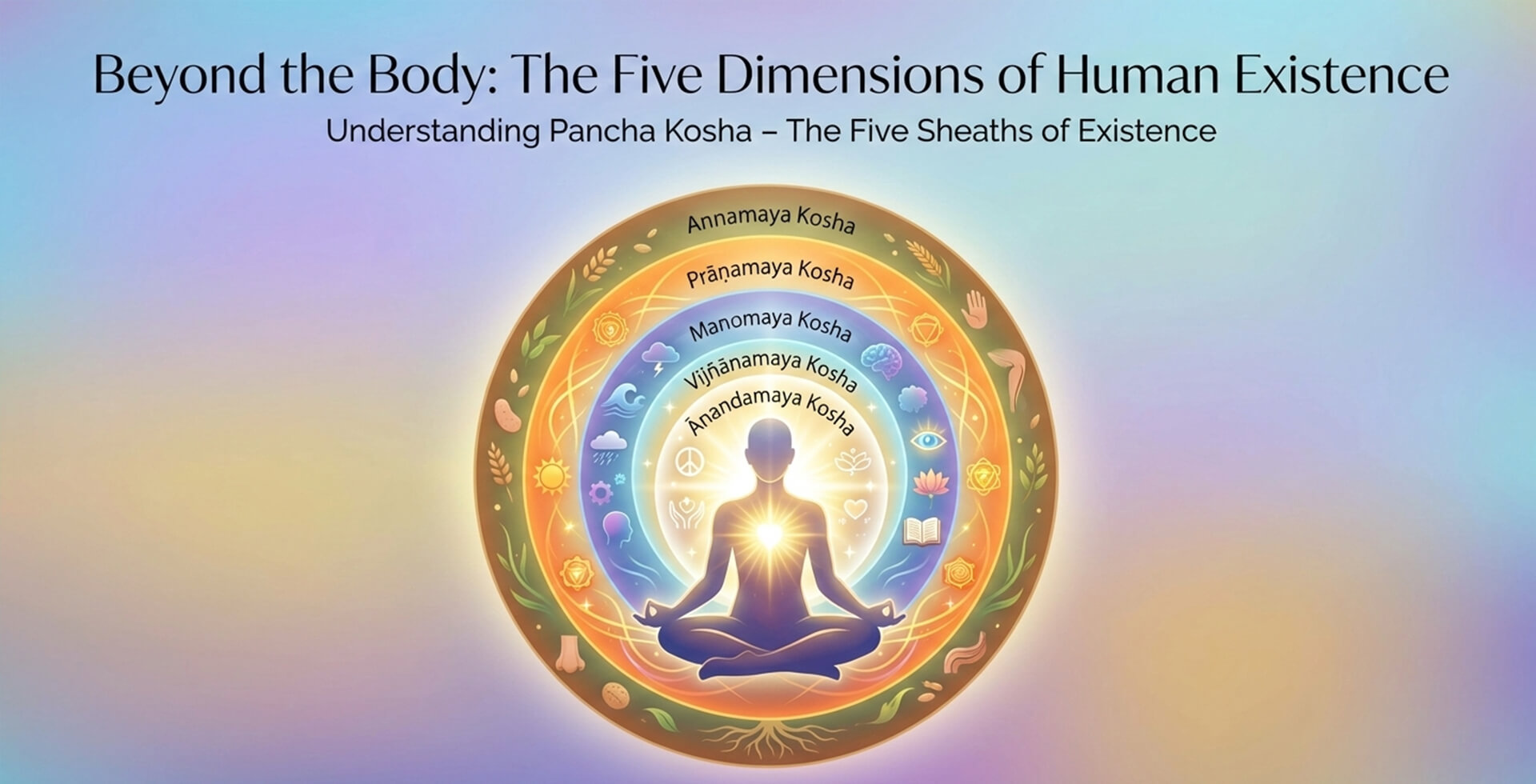
In the process of exploring these deeper dimensions, the concept of Pancha Kosha—the five sheaths of human existence—was revealed. Although this idea appears in various texts, its clearest and most systematic exposition is found in the Brahmānandavallī (Anuvāka 2–5) of the Taittirīya Upaniṣad, where a human being is described as having five concentric sheaths, each subtler than the previous one.
The five koshas are:
- Annamaya Kosha
- Prāṇamaya Kosha
- Manomaya Kosha
- Vijñānamaya Kosha
- Ānandamaya Kosha
- Annamaya Kosha
Annamaya Kosha is the outermost sheath of our existence and has the least degree of freedom.
The word Anna means food or nourishment, referring to the physical body. This is why it is said, “We are made of what we eat.”
The Upaniṣadic declaration beautifully states:
“Annaṃ brahmeti vyajānāt” — Food itself is Brahman (Taittirīya Upaniṣad).
According to Ayurveda, the physical body is composed of Sapta Dhātus (seven fundamental tissues):
Rasa Dhatu – Plasma and lymph
Nourishes all tissues, maintains hydration, and supports immunity and circulation.
Rakta Dhatu – Blood
Responsible for oxygenation, vitality, skin glow, and life force (jīvana).
Māṃsa Dhatu – Muscle tissue
Provides strength, stability, posture, and physical form.
Meda Dhatu – Fat and adipose tissue
Lubricates joints, stores energy, and provides insulation and softness.
Asthi Dhatu – Bone tissue
Forms the skeletal structure and supports teeth, nails, and hair.
Majjā Dhatu – Bone marrow and nervous tissue
Fills bones, nourishes the nervous system, and supports cognition and coordination.
Śukra Dhatu – Reproductive tissue
The essence of vitality, creativity, immunity, and the formation of ojas.
The physical body is continuously subjected to change—birth, growth, aging, disease, and death. Hence, in terms of freedom and permanence, Annamaya Kosha is the most limited.
Prāṇamaya Kosha
For the body to function, energy is essential. This vital life force is known as Prāṇa. The energetic sheath that pervades the entire body is called Prāṇamaya Kosha.
Prāṇa is classified into five functional aspects:
Prāṇa – Inhalation, heart and chest functions, intake of energy
Apāna – Excretion, elimination, grounding processes
Samāna – Digestion, assimilation, and balance
Udāna – Speech, growth, upward movement, and willpower
Vyāna – Circulation, coordination, and expansion throughout the body
In yogic philosophy, this vital energy flows through subtle channels known as Nāḍīs.
Manomaya Kosha
Manomaya Kosha is the third sheath of our existence. It is composed of thoughts, emotions, memories, sensory perceptions, and habitual reactions.
Information received through the five sense organs is processed by the mind, which then reacts and interprets the world. This kosha gives meaning to experiences and shapes our inner and outer reality.
Subtler than Prāṇamaya Kosha, Manomaya Kosha plays a crucial role in inner growth. When the mind shifts from automatic reactions to conscious awareness, it becomes a gateway to deeper wisdom and healing.
Vijñānamaya Kosha
Human beings experience a wide spectrum of emotions, but survival and growth require a guiding intelligence that can discriminate between what is beneficial and what is harmful. This faculty of discernment (Viveka) belongs to Vijñānamaya Kosha.
This fourth sheath is made up of intellect, wisdom, insight, and inner knowing. It governs understanding, decision-making, values, and conscious choices. Vijñānamaya Kosha helps align life with truth and purpose.
Ānandamaya Kosha
Ānandamaya Kosha is the subtlest sheath of existence and possesses the maximum degree of freedom. It is known as the body of bliss.
This sheath reflects our natural state of peace, contentment, and wholeness. Beyond thoughts and emotions, it is a pure state of being. One experiences this bliss in deep silence—free from duality.
Ānandamaya Kosha is felt as profound joy, peace, and fulfillment, transcending pleasure and pain. It is not an emotion, but a state of existence itself.