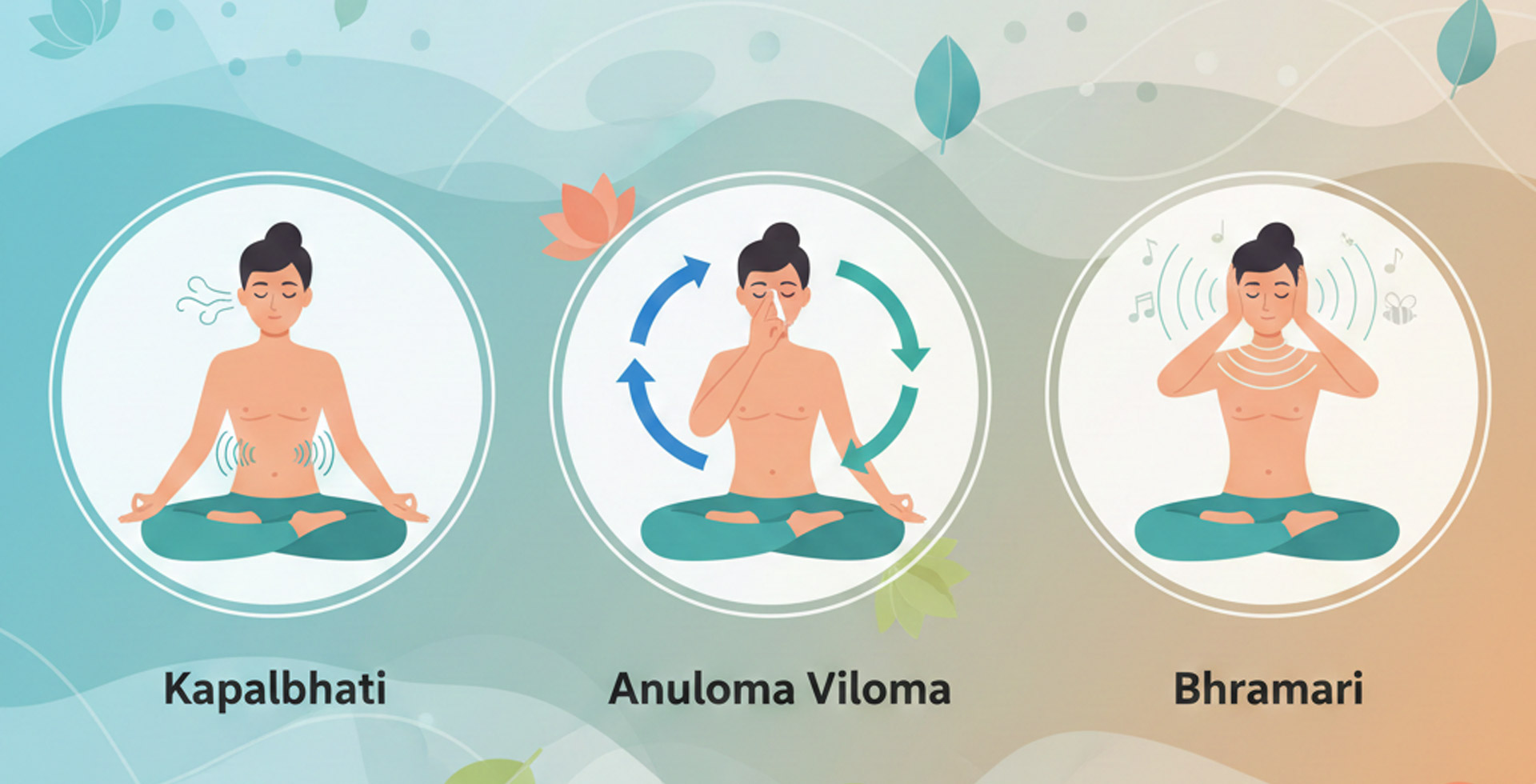
Balanced breathing guide
One of the eight limbs of Patanjali’s Ashtanga Yoga—also known as Raja Yoga—is Pranayama. Once we establish physical steadiness through Asana practice, we can begin to balance the flow of vital energy, i.e., Prana. There are various pranayama techniques that offer profound benefits. For a person without major health concerns, three essential practices can be included in daily sadhana.
Kapalbhati
Sit straight with relaxed shoulders, preferably in Sukhasana, Padmasana, or Vajrasana. Actively exhale with rhythmic abdominal flapping; inhalation remains passive. Practice 80–100 strokes and repeat for 3 sets.
Contraindications:
This practice should be avoided in conditions such as high blood pressure, heart diseases, hernia, pregnancy, post-partum phase, severe back or spinal issues, peptic ulcers, GERD or severe gastritis, recent abdominal surgery, epilepsy or seizure disorders, vertigo, migraine, and severe headaches.
Benefits:
- Strengthens the respiratory system by improving lung capacity and clearing air passages.
- Boosts digestive fire (Agni) and enhances metabolism.
- Improves blood circulation and cellular oxygenation, increasing energy.
- Aids detoxification by expelling stale air and mucus.
- Enhances mental clarity, concentration, and pranic activity.
- Balances the nervous system and uplifts overall mood.
Anuloma Viloma
Sit straight with relaxed shoulders and adopt Nasika Mudra. Close the left nostril and exhale through the right. Inhale through the right nostril, close it, then exhale through the left. Inhale through the left, close it, and exhale through the right. Continue this alternate nostril pattern rhythmically.
Contraindications:
Avoid this practice during severe cold, nasal congestion, acute sinusitis, fever, very low blood pressure, uncontrolled high blood pressure, recent heart attack or major cardiac issues, severe asthma attacks, dizziness or vertigo, epilepsy, recent chest or abdominal surgery, or during extreme fatigue, breathlessness, or mental instability.
Benefits:
- Balances the nervous system and calms both mind and body.
- Improves lung capacity and overall respiratory efficiency.
- Reduces stress, anxiety, and restlessness by activating relaxation responses.
- Harmonizes both brain hemispheres, improving focus and mental clarity.
- Purifies the nadis and enhances pranic flow.
- Stabilizes emotions and supports deeper meditation.
Bhramari
Sit straight with relaxed shoulders. Close the ears gently with your palms, keep the eyes closed, take a deep breath, and while exhaling create a soft humming sound like a bee. Repeat this 9 times.
Contraindications:
Bhramari should be avoided in severe ear infections, recent ear or throat surgeries, uncontrolled high blood pressure, epilepsy or seizure disorders, severe migraine or intense headaches, and in cases of extreme dizziness, panic, or breathlessness.
Benefits:
- Instantly reduces stress and anxiety by soothing the nervous system.
- Helps lower blood pressure and relax the cardiovascular system.
- Improves concentration and mental clarity through vibrational focus.
- Releases emotional tension and reduces anger, irritability, and frustration.
- Enhances sleep quality and helps manage insomnia.
- Soothes the throat and strengthens vocal cords with gentle sound vibrations.
Practice early in the morning, on an empty stomach, in a well-ventilated and well-lit space for maximum benefit.